Everything that makes a mining site work arrives on a truck. The transformer, the switchgear, the containers, the gensets. Most of it is heavy enough, tall enough or wide enough that it cannot simply be driven to the gate, and the people quoting you on equipment are rarely the people who have looked at the road.
This is not the same problem as shipping miners. Moving a pallet of ASICs is freight, and our guide to stocking spares covers that end of it. This is heavy haul, which is a different industry with different rules, and it is the part of a buildout schedule that most often turns out to be the long pole.
What Actually Decides Whether the Load Arrives
Weight, and where it sits
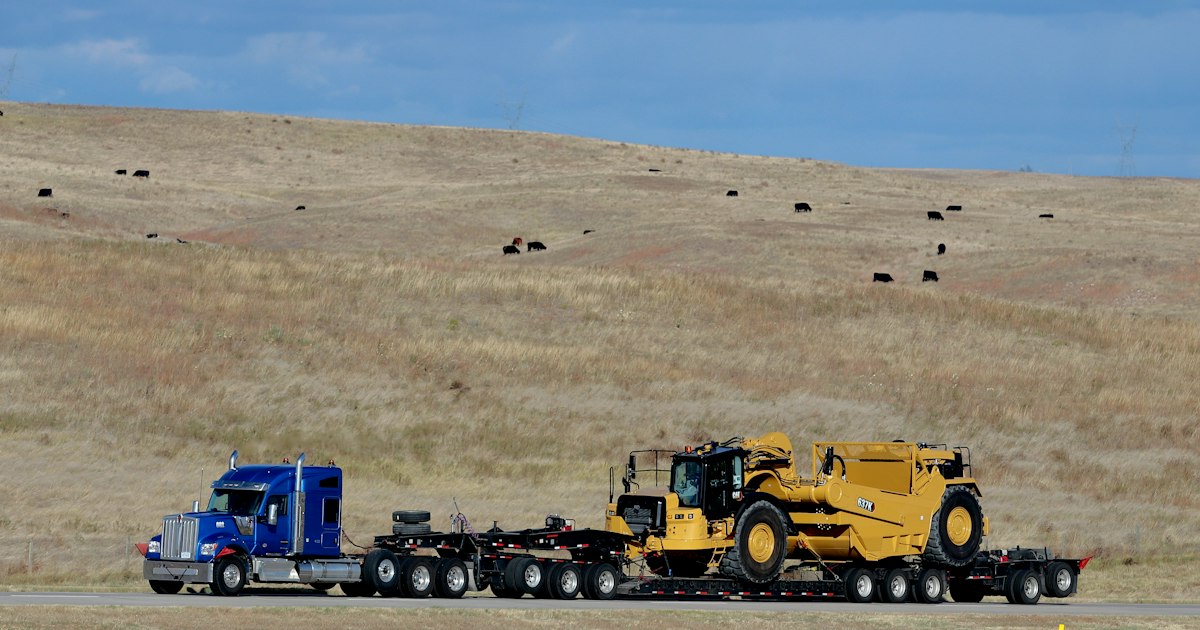
A medium-voltage transformer for a multi-megawatt site can weigh more than a loaded highway truck on its own. That weight has to be spread across enough axles to stay inside legal limits, which is why heavy haul uses multi-axle lowboys rather than a standard flatbed. More axles means a longer rig, and a longer rig needs more room to turn.
Gross weight is only half of it. Axle loading is what bridges and culverts care about, and that is a function of how the load is positioned on the trailer, not just how much it weighs.
Height
Standard highway clearance runs around thirteen feet six inches in most of the United States, and many older structures are lower. A container on a lowboy may clear comfortably. A transformer on a lowboy frequently does not, and the fix is either a route that avoids the obstruction or a different trailer that sits the load lower, which costs more and takes longer to arrange.
Height is the constraint that most often forces a route change, and it is the easiest one to check early.
Width and length
Anything over about eight and a half feet wide is an oversize load, which triggers permits, and above certain widths, escort vehicles. Containers are generally fine. Transformers, cooling equipment and some skid-mounted gensets are often not.
The Permits Are Not the Problem. The Route Survey Is
Oversize and overweight permits are routine. Your carrier obtains them, they are issued per state, and they come with conditions on timing and routing. That part is paperwork.
The part that actually bites is the route survey, and on a rural mining site it is the step most likely to be skipped.
A route survey is somebody physically driving the proposed route and looking at it. What they are looking for is specific:
- Bridge and culvert ratings on the last few miles. County roads often have posted limits well below the state highway that feeds them, and a posted limit is not a suggestion.
- Turning radii at every intersection the rig has to negotiate. A ninety-degree turn from a narrow county road onto a narrower site access road is where heavy haul deliveries most often fail.
- Overhead obstructions, which on rural roads are usually utility lines and tree canopy rather than bridges. Tree canopy is cheap to fix with advance notice and expensive to discover on delivery day.
- Soft shoulders and ditches, because a rig that has to swing wide onto an unpaved shoulder to make a turn needs that shoulder to carry the weight.
Do the survey before you commit to a delivery date, not after. A route problem found three weeks out is a planning adjustment. The same problem found on delivery day is a rig sitting on a county road with your transformer on it.
The Last Hundred Yards
The site entrance and the pad are where more deliveries go wrong than on the public road, because the public road at least was built for vehicles.
Your access road needs to carry the rig, not just the finished weight of the equipment. A pad designed for a container that will sit there permanently is a different specification from an access route that has to carry a loaded multi-axle trailer on the way in. Our guide to site preparation and civil works goes through what that base actually needs to be.
Three things worth confirming before the truck is scheduled:
Turning space at the gate. A lowboy cannot back up around a corner. It needs either a straight approach or enough room to swing.
A staging area. If the crane is not ready when the truck arrives, the load has to wait somewhere that is not the public road. Detention charges accrue by the hour.
Ground conditions on the day. A gravel pad that carries a rig in August may not carry it after a week of rain. This is the single most common reason a delivery slips, and it is weather, so it cannot be fully planned away. It can be scheduled around.
Seasonal Restrictions Nobody Mentions Until They Apply
Two timing constraints exist that have nothing to do with your schedule and cannot be negotiated.
Frost laws. In northern states, counties post reduced weight limits during the spring thaw, when the subgrade under a rural road softens as it melts from the top down. The posted reduction is often substantial and it applies to exactly the roads a mining site sits on. Depending on the year it can run for several weeks, and the dates are not fixed in advance because they depend on the weather.
For a site in Nebraska, Iowa, the Dakotas or anywhere with a real winter, this means there is a window each spring where heavy deliveries are effectively impossible on the last few miles. If your energization date sits just after that window, the delivery has to happen before it, which can pull a transformer order forward by a month or more.
Permit timing conditions. Oversize permits routinely prohibit movement at night, in poor visibility, during peak hours, and on holidays and holiday weekends. A load that needs daylight and good weather has a narrower delivery window than the calendar suggests, and in winter that window is short.
Neither of these shows up on a procurement schedule. Both are worth asking your carrier about before you pick a date, because the carrier knows and will usually tell you if asked.
Escorts and police escorts
Above certain dimensions a load requires pilot vehicles, and above others it requires a police escort arranged through the relevant jurisdiction. Police escorts are scheduled around the department’s availability, not yours, which adds lead time that is entirely outside your control. Find out early whether your load triggers one.
Sequencing: What Arrives First
Deliveries interact, and the order matters more than people expect.
Heavy electrical equipment generally wants to arrive before the site is congested with containers, because once containers are set the access routes narrow and crane positions get constrained. Equally, the transformer cannot be set before its pad has cured, and pads are poured on a schedule that depends on weather.
The practical approach is to work backwards from the energization date, allow genuine float for weather, and treat each heavy delivery as a milestone with its own crane and its own access requirements rather than as a line on a materials list. Our write-up of crane day for a 1MW container covers what that looks like at the setting end.
If transformers are in the critical path, and on most buildouts they are, the lead time conversation and the delivery conversation need to happen together. Our guide to transformer lead times covers the procurement half.
Who Carries What Risk
Worth reading before signing anything.
When does title transfer? If it transfers at the supplier’s dock, the equipment is yours for the whole journey and your insurance is carrying it. If it transfers on delivery, it is theirs. This is a one-line answer that changes who files a claim if something happens on the road.
Who arranges the carrier? A supplier arranging freight on your behalf is not the same as a supplier being responsible for the delivery. Ask which it is.
Who is responsible for site access? Almost always you. If the rig cannot reach the pad because of a condition on your property, that is your cost, including the return trip.
What happens on a failed delivery? Expect to pay for the attempt, the detention and the rescheduling. Knowing the number in advance is better than discovering it on an invoice.
A Short Checklist
Before you accept a delivery date for any major piece of equipment:
- Dimensions and weight confirmed in writing by the supplier, not estimated from a datasheet
- Route survey completed by somebody who drove it, including the final county roads
- Bridge and culvert ratings checked on the last few miles
- Turning radius at the site entrance confirmed against the rig length
- Pad cured and access road rated for the loaded rig, not just the static equipment
- Crane scheduled and confirmed for the delivery window, with a staging plan if it slips
- Permits obtained and their timing conditions understood, since many prohibit night or weekend movement
None of this is difficult. It is just a step that often has no owner, because the electrical contractor assumes the supplier handles it, the supplier assumes the carrier handles it, and the carrier assumes somebody checked the road.
Where Rax Mining Fits
Our hosted facilities already have the access, the pads and the crane positions sorted, which is one of the less visible reasons hosting is faster than building. Customers deploying into our capacity do not inherit any of this.
If you are building your own site and want to talk through the logistics side before you commit to equipment dates, get in touch.
Explore Rax Mining
- Bitcoin Miner Hosting — Competitive rates from $0.075/kWh
- NatGas MDU Units — 1MW modular datacenter containers
- Mining Profitability Calculator — Estimate your mining returns
- Our Facility — Tour our mining infrastructure