Stormwater shows up on mining site schedules as a permit. There is a line item for it, an environmental consultant attached to it, and a date by which it has to be filed. That work is necessary and it is well covered: our guides to facility permitting and environmental compliance both walk through the filings, and projects disturbing more than roughly an acre of ground generally need a construction stormwater permit before any dirt moves.
Filing the permit and managing the water are different jobs. The permit asks what you intend to do. The rain asks whether it works. Sites fail the second test years after passing the first, and the failures are rarely dramatic. They look like a trench that is wet every spring, a transformer pad settling on one corner, a service road that becomes impassable in the week you need a truck on it.
This is about the second job.
You create the problem by building the site
Before construction, rain landing on the parcel mostly soaked in where it fell. The site changes that, and the change is larger than people expect.
A container pad is an impervious surface. So is a concrete transformer pad, a compacted gravel yard, a parking area, and the roof of every container. Water that used to infiltrate now lands on something hard and leaves, immediately and all at once. The same storm that produced a slow soak before construction produces a fast sheet of moving water afterward.
Two consequences follow. The volume leaving your property goes up, which is what the permit cares about. And the water now moves with enough energy to pick up and carry material, which is what your equipment cares about.
Container roofs are the piece most often left out of the arithmetic. A row of containers is a substantial roof area, discharging at specific points along its edges, usually straight onto the gravel beside the unit. That is a concentrated flow in a place where nobody designed for one.
Catch, convey, slow, release
Drainage design is four questions in order, and most site problems are a missing answer to one of them.
Catch. Where does water land, and which way does it go from there? This is the grading question that our site preparation guide covers in principle. The rest of this article assumes that work was done and asks what happens next.
Convey. Once water is moving, what carries it across the site? This is the step most often left to chance, on the theory that water will find its own way. It will, and the path it chooses will be the one that erodes most easily.
Slow. Does the water have to be held before it leaves? If a permit sets a release rate, the answer is yes, and that means a basin.
Release. Where does it go when it leaves your property, and what does it do to that place on the way out?
Open channels beat buried pipe on a remote site
Conveyance comes down to a graded channel or a buried pipe, and remote mining sites have a clear preference that runs against normal commercial instinct.
A buried system is tidier and lets you drive anywhere. It is also invisible. When it blocks you find out during the storm, from water appearing somewhere unexpected, and clearing it needs equipment you do not have on site.
A graded open channel is less tidy and crosses the yard where you might rather drive. In exchange, it is inspectable by walking the site, and a blockage is visible before it matters and clearable with a shovel. On a site with no full-time civil staff and a long drive for any contractor, being able to see and fix the thing yourself is worth more than neatness.
The practical compromise most sites land on is open channels for the main routes, with pipe only where something has to be driven across. Which brings up the crossing.
The access road crossing is the single highest-consequence detail
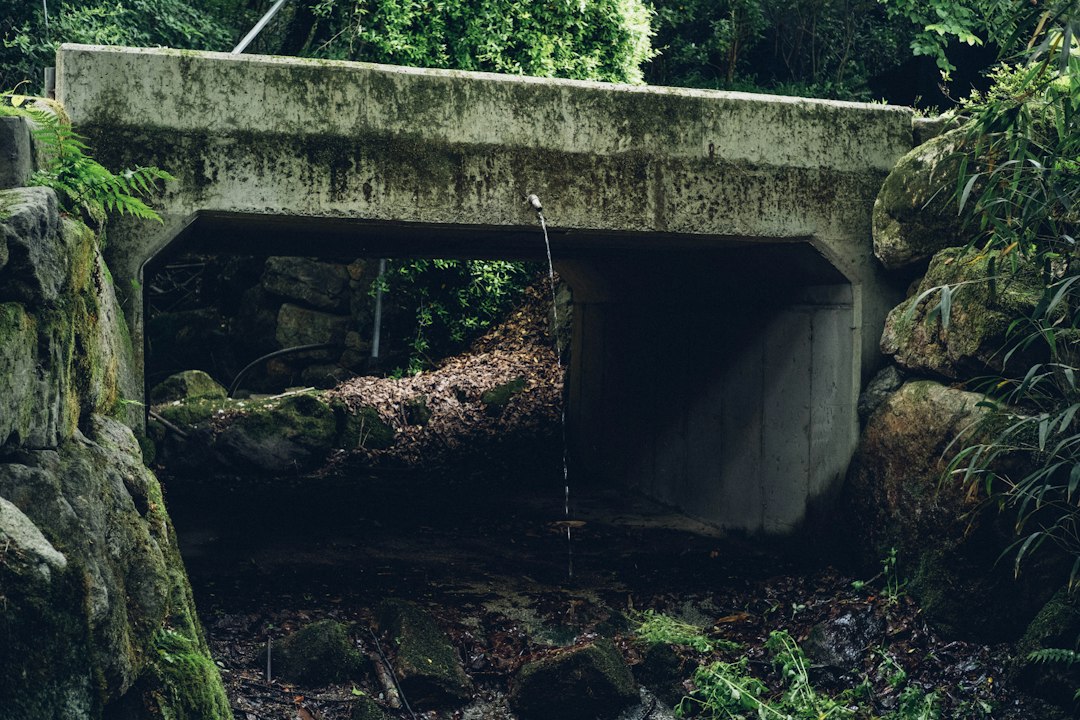
Where a drainage route crosses the road into your site, there is a pipe under the road. That pipe is the most consequential small component on the property, because the road above it is how everything reaches you.
Undersize it, or let it silt up, and a heavy storm backs water up behind the road, saturates the fill, and takes out a section of it. The failure is not the pipe. The failure is that nothing can get in or out, including the service truck for whatever else the storm broke. Our guide to getting heavy equipment to a mining site covers what it takes to move a load up that road in the first place; a washed-out crossing is how that access is lost after it was proven.
Two things follow from treating it as critical rather than incidental. It gets sized by someone who does hydrology for a living, against the design storm your jurisdiction specifies, not matched to whatever pipe diameter was already there. And it goes on the inspection list permanently, because a crossing that has worked for four years is a crossing that has had four years to accumulate sediment and debris.
Basins are an operational commitment, not a one-time build
If your permit requires you to hold water and release it at a controlled rate, you will have a basin. A basin is not a hole that solves a problem. It is a piece of equipment with a maintenance requirement.
Basins work by filling during a storm and draining slowly through a controlled outlet afterward. Everything the water carried in settles out while it waits. That is the point, and it is also the failure mode: sediment accumulates, storage volume shrinks, and a basin largely full of silt no longer does the job the permit credited it with. The outlet is the other half, because a partially blocked outlet turns a detention basin into a pond.
Neither problem announces itself. Both are found by looking, which is why the inspection schedule in the permit exists and why it is worth doing properly rather than treating it as paperwork.
The outfall is where most sites actually fail
The most common drainage failure on an industrial site is not flooding. It is erosion where concentrated water leaves a channel or pipe and hits bare ground.
Water arriving through a pipe is moving faster than the sheet flow the ground is used to. It scours. The scour works backward toward the pipe, undermines whatever the pipe is bedded in, and eventually the outlet is hanging in the air over a gully that is growing toward your site every storm.
The fix is energy dissipation at the discharge point, which in practice means armoring the ground where the water lands so that it slows down before it reaches anything erodible. This is cheap at construction and genuinely expensive to retrofit, because by the time you are retrofitting, there is a gully to rebuild as well as an outlet to protect.
Four things specific to a mining site
Cable trenches are drains whether you intended them or not. A backfilled trench is looser material than what surrounds it, and it runs in a straight line between places you care about. Water follows it. A trench that carries water to a junction box or a container base is a slow failure with an electrical ending, and it is worth knowing where your trenches sit relative to the grading.
Containment is not drainage, and the two must not be connected. Secondary containment around fuel and oil exists to keep a release from leaving. If containment drains into the stormwater system, it has been defeated. Our guide to fuel and oil spill containment covers how that interface is supposed to work; the drainage design has to respect it rather than quietly undo it.
Cooling discharge is a separate regulatory question. Blowdown from an evaporative system is process water, not rainfall, and it is governed by different rules. Our articles on cooling tower blowdown and water sourcing and water rights cover that side. Routing it to a storm drain because the storm drain is nearby is a compliance problem, not a convenience.
Gravel migrates. A gravel yard with water running across it loses material into the drainage system, which deposits in the first place the flow slows down: the basin or the crossing. The yard gets thinner and the basin gets shallower in the same storm.
Cold climates change the question
Everything above assumes water that flows. For part of the year in much of North America, it does not.
An open channel that carries meltwater by day and freezes by night fills with ice from the bottom up, and by the time of a real thaw its capacity is a fraction of design. Culverts do the same, and a blocked culvert during snowmelt is the access road problem described above, arriving in the season when the ground is already soft. Our guide to snow and ice at remote mining sites covers the broader seasonal picture.
Snow storage is the related planning item nobody sketches. Plowed snow has to go somewhere, it melts in place, and where it sits in February determines where water is in April. Piling it on the upslope side of a container row is a decision about where meltwater goes, made months in advance by someone who was only trying to clear a road.
What to actually do
For a site in design, the useful sequence is: have the civil scope include conveyance and outfalls rather than stopping at the pad; get the road crossing sized by a hydrologist against the local design storm; locate cable trenches with the grading in front of you; and decide where plowed snow goes before the first winter rather than during it.
For a site already running, the highest-value hour is a walk after the next heavy rain, while the evidence is still visible. Water will have told you where it goes. Look for scour at discharge points, standing water near equipment and trench lines, gravel deposited where flow slowed, and the condition of the road crossing. Those four observations find most of what is wrong, and they cost nothing but the walk.
Drainage is unglamorous, and it is one of the few civil decisions that is genuinely cheap during construction and expensive afterward. It also decides, more than most line items, whether the site is still straightforward to operate in year five.
If you would rather not own these decisions at all, hosting moves them to someone whose job is site infrastructure. Our breakdown of what hosting actually costs per kilowatt-hour sets out what that covers, and you are welcome to talk to our team about either path.
Explore Rax Mining
- Bitcoin Miner Hosting — Competitive rates from $0.075/kWh
- NatGas MDU Units — 1MW modular datacenter containers
- Mining Profitability Calculator — Estimate your mining returns
- Our Facility — Tour our mining infrastructure