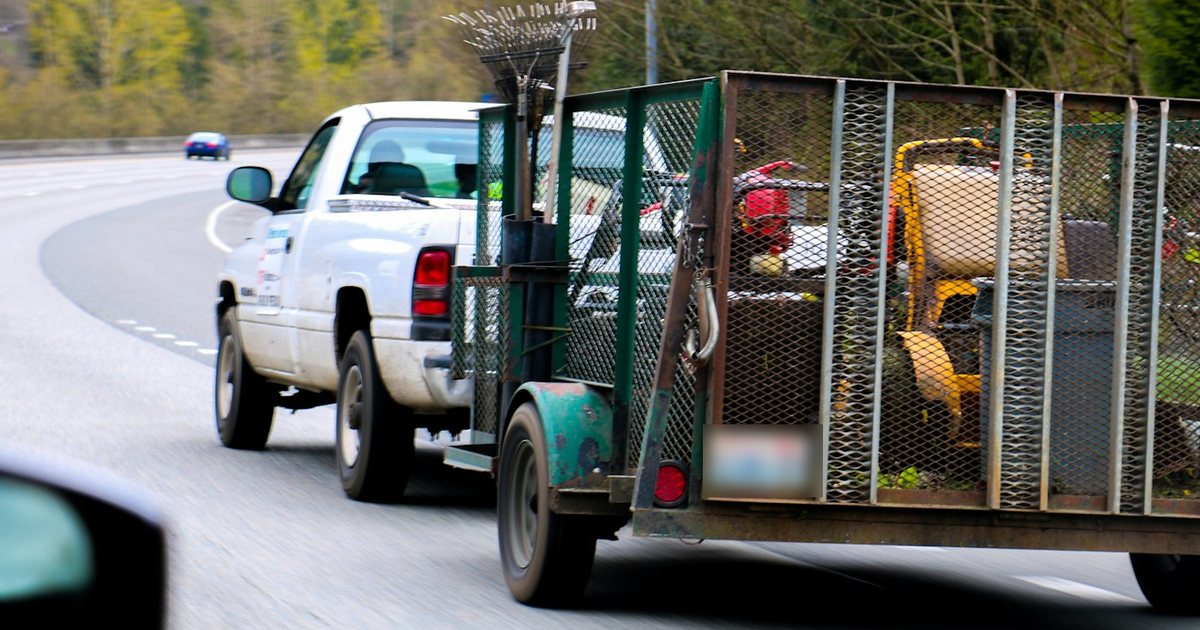
The truck is a three-quarter-ton pickup. Behind it is an equipment trailer carrying a spare transformer, a pallet of PDUs and a generator on a skid. The two techs in the cab have done this run a dozen times. Today a state trooper pulls them onto the scale at the county line, and inside ten minutes the conversation has gone somewhere nobody expected: there is no USDOT number on the door, neither tech holds a medical examiner’s certificate, and nobody on site can produce a record of hours worked. The trailer is placed out of service. The transformer does not arrive. And the company now exists in a federal database it did not know it belonged in.
Nothing illegal was intended and nothing dangerous happened. The operation simply crossed a weight line that has no sign posted on it, in a truck that looks exactly like every other pickup on the road.
This is the most reliably overlooked compliance exposure in building and running a remote site, because it does not look like trucking. Hiring a heavy-haul carrier to deliver containers is obviously trucking, and the rules there belong to the carrier – we covered that side of it in getting heavy equipment to a site. Sending your own two people out with your own truck and your own trailer does not feel like trucking at all. The regulations disagree, and they draw the line by arithmetic rather than by intent.
The Arithmetic, and It Is the Whole Article
The Federal Motor Carrier Safety Regulations apply to a “commercial motor vehicle.” The definition is a weight test, and you can run it yourself in about two minutes with a flashlight.
Step one: find the ratings, not the scale weight.
- The truck’s gross vehicle weight rating is on the certification label, usually on the driver’s door jamb.
- The trailer’s gross vehicle weight rating is on its own VIN plate, usually on the front left frame rail or the tongue.
- The gross combination weight rating is the manufacturer’s limit for truck plus trailer together, published in the owner’s manual and often on the same door label.
Step two: take whichever is greater, the rating or what you actually weigh loaded. The rule uses gross vehicle weight rating, gross combination weight rating, gross vehicle weight or gross combination weight, whichever is greater. You cannot rate your way out of it by running light, and you cannot weigh your way out of it by having a high rating you never use.
Step three: compare against two numbers.
- 10,001 pounds. At or above this, the vehicle or combination is a commercial motor vehicle, assuming it is being used in interstate commerce to transport property. No commercial driver’s license is involved at this level. The obligations are the carrier’s and the driver’s all the same.
- 26,001 pounds. At or above this as a combination, where the towed unit is rated over 10,000 pounds, the driver needs a Class A commercial driver’s license. At or above this as a single vehicle, the driver needs a Class B.
Two worked examples, using round hypothetical ratings rather than any specific product:
Example one. A pickup rated at 10,000 pounds towing an equipment trailer rated at 7,000 pounds gives a combination of 17,000 pounds. That is well past the first threshold and nowhere near the second. The result is the configuration almost nobody recognizes: a commercial motor vehicle operated by a driver who needs no commercial driver’s license at all. This is the single most common mining-site truck in the country, and it is the single most common compliance blind spot.
Example two. The same pickup pulling a 14,000-pound gooseneck gives 24,000 pounds. Still under the license threshold, but only by 2,000 pounds. Spec the next trailer up at 16,000 and the combination is 26,000 – one pound short, and a rounding error away from needing a licensed driver for every run. That is a purchasing decision with a staffing consequence attached to it, and it gets made by whoever is buying the trailer, usually without anyone mentioning this.
The Second Trap: “Interstate” Does Not Mean “Crosses a State Line”
Operators who do the weight math often stop at the next step, because they are confident the trucks never leave the state. That confidence is usually misplaced.
Interstate commerce, in this context, is about the nature of the movement rather than the geography of the trip. If the freight is part of a journey that begins or ends outside the state – even if your particular leg of it is entirely local – that leg is generally treated as interstate commerce. The miners that arrived at the port and are being hauled the last sixty miles to the site are in interstate commerce for that final sixty miles. So is a transformer shipped in from out of state and picked up at a local distributor’s yard for delivery to the pad.
This catches rural operations repeatedly, because very little of what goes into a mining site originates inside the state it is built in. The practical version of the test is not “did my truck cross a line today.” It is “where did this load start, and where is it ultimately going.”
And if the answer genuinely is purely intrastate, that is not the end of it either. Most states have adopted some version of these rules for intrastate operations, and the weight threshold they adopt is not always the federal one. Some mirror it exactly. Others start at a higher number. That is a state-by-state lookup and it has to be done for the state you operate in, not inferred from a neighbor.
What Actually Applies, by Band
The useful thing to understand is that the requirements arrive in two distinct waves, not one. Crossing the first threshold brings on a substantial list. Crossing the second adds licensing and testing on top.
| Requirement | Under 10,001 lb | 10,001 lb and up, under 26,001 | 26,001 lb and up |
|---|---|---|---|
| USDOT number and vehicle marking | No | Yes | Yes |
| Driver qualification file | No | Yes | Yes |
| Medical examiner’s certificate | No | Yes | Yes |
| Hours-of-service limits | No | Yes | Yes |
| Records of duty status or time records | No | Yes | Yes |
| Annual vehicle inspection and driver inspection reports | No | Yes | Yes |
| Accident register | No | Yes | Yes |
| Commercial driver’s license | No | No | Yes |
| Federal drug and alcohol testing program | No | No | Yes |
That middle column is the one worth staring at. It is an entire safety-compliance program attached to a pickup and a trailer, triggered by a number on a sticker, with no license requirement anywhere in it to signal that anything changed.
The last row is a genuinely useful distinction and it is routinely gotten wrong in both directions. The federal drug and alcohol testing rules – pre-employment, random, post-accident, the whole program, plus the national clearinghouse query and reporting duties – attach to drivers who are required to hold a commercial driver’s license. A driver operating a 17,000-pound combination is not in that program by federal rule. That is not the same as saying testing is a bad idea, and it is certainly not the same as saying your insurer or your client contracts do not require it. It means the obligation, if you have one, comes from somewhere other than this particular regulation.
The Short-Haul Exception Is the Provision That Makes This Livable
If you read the hours-of-service rules cold, the compliance picture looks grim: an electronic logging device in every pickup, duty-status records for every tech, and a daily administrative burden out of all proportion to two people driving forty minutes to a site.
There is a specific provision that exists for exactly this situation, and most of the operations that need it have never heard of it. A driver who operates within a 150 air-mile radius of the normal work reporting location, and who returns to that location and is released from duty within 14 consecutive hours, is excepted from the requirement to keep records of duty status – which also means no electronic logging device for that driver.
Three points about it that matter more than the headline:
- Air miles, not road miles. A 150 air-mile radius is a circle drawn on a map, and road distance inside it is longer. The radius is more generous than it sounds.
- You still have to keep time records. The exception removes the duty-status log, not the recordkeeping. The carrier keeps records showing the start time, the end time and total hours on duty for each day, retained for the required period. If you have no records at all, you are not using the exception – you are simply non-compliant with better optics.
- The driving limits still apply. The exception is about paperwork, not about hours. The 11-hour driving limit, the 14-hour window and the weekly limits are unchanged.
For a site within a couple of hours of the shop, with crews that start and finish at the same place, this provision is the difference between a manageable program and a fleet-telematics project. Structuring the work to stay inside it – same reporting location, same-day return – is a scheduling decision worth making deliberately.
The Hours Themselves, Since They Drive the Schedule
For drivers hauling property, the federal limits are: a maximum of 11 hours of driving after 10 consecutive hours off duty; all driving must finish within a 14-hour window that starts when the driver comes on duty and does not pause for breaks; a 30-minute break required after 8 cumulative hours of driving time; and a weekly ceiling of 60 hours in 7 days or 70 hours in 8 days depending on the operating schedule.
The 14-hour window is the one that bites at remote sites, because it does not stop running while the crew works. A driver who comes on duty at six in the morning, drives two hours out, spends nine hours doing an install, and then has to drive two hours back is at seventeen hours on the clock. The driving at the end of that day is outside the window, regardless of how much of the 11 hours of driving time remains unused. This is a real operational constraint on how far a site can be from the shop before the work needs either an overnight or a second crew. Note that it is a separate question from the human-factors one – whether the crew is actually fit to drive home is a judgment about the person, while the 14-hour window is a hard legal ceiling that applies whether or not anyone feels tired. Both belong in the planning conversation, alongside the rest of the site’s safety program.
What Being a Motor Carrier Actually Obliges You To Do
Once the weight math says yes and the commerce test says yes, you are a motor carrier, and the obligations sit with the company rather than with whoever happened to be driving.
- Register and get a USDOT number, then display it on both sides of the power unit, legibly from a distance, with the legal or trade name of the operating entity.
- Keep the registration current. The biennial update is required even if nothing has changed and even if you stopped operating, and a lapsed registration is its own violation.
- Build a driver qualification file for each driver – application, the motor vehicle record inquiries, the road test or equivalent, the medical certificate, and the annual review of driving record.
- Medical certification. Interstate drivers of a commercial motor vehicle must be physically qualified and hold a current certificate from a listed examiner. This one surprises people most, because it applies to the tech in the pickup, not just to the person in a tractor-trailer.
- Vehicle inspection program. An annual inspection for each vehicle, with records retained, plus the daily driver inspection and report cycle.
- Accident register. A maintained record of recordable accidents, which is one of the first things requested in an audit.
- Keep the records where you can produce them. Most of the pain in a compliance review is not the violation itself. It is the inability to demonstrate a practice that was, in fact, being followed.
Where the Real Money Is, and It Is Not the Fine
Civil penalties for this category of violation are real, but they are rarely what makes the difference to a business. Three other exposures are larger.
The out-of-service order. A vehicle placed out of service does not move until the defect is corrected, and a driver declared out of service for hours or qualification reasons does not drive. The load stops where it stopped. If that load is the switchgear your energization date depends on, the cost is the schedule slip, not the citation.
Your safety record becomes public. Carrier safety data is visible to anyone who looks, including the counterparties who are deciding whether to do business with you. Roadside inspection results feed it.
Litigation after an accident. This is the one that should concentrate the mind. If a company vehicle is involved in a serious crash, opposing counsel’s first move is to establish what the company knew and what it required. An unqualified driver, no medical certificate on file, no hours records and no inspection program is not a technical violation in that setting – it is the theory of the case. The company’s own missing paperwork becomes the evidence that the company was indifferent, and that is how a vehicle claim becomes a corporate one.
Separately, and worth a direct conversation with your broker rather than an assumption: the federal minimum financial-responsibility filings are aimed principally at for-hire carriers and at hazardous materials. A private carrier moving its own non-hazardous property generally sits outside those particular filing requirements. That is not remotely the same as being adequately insured, and it says nothing about whether your commercial auto policy anticipates the configuration you are actually running.
Three Postures, and the Cheap One Is Often Right
| Posture | What it means | Cost | Flexibility | When to choose it |
|---|---|---|---|---|
| Stay under the line | Spec trucks and trailers so no combination is rated at 10,001 pounds or more, and hire out anything heavier. | Lowest ongoing. Possibly higher per-move cost, and a smaller trailer. | Lowest. Some moves simply cannot be done. | Single site, infrequent heavy moves, small team, no appetite for an administrative program. This is the right answer more often than operators assume, and it is almost never evaluated because the trailer gets bought before the question is asked. |
| Run a compliant in-house program | Register, qualify the drivers, build the files, use the short-haul exception, inspect on a schedule. | Moderate and ongoing. One person has to own it. | Highest. You move what you want, when you want. | Multiple sites, frequent moves, crews already on payroll, and a real need to respond to a failure the same day. The short-haul exception is what keeps this proportionate. |
| Hire a carrier for everything | Every movement of equipment is somebody else’s regulated activity. | Highest per move. No compliance overhead. | Lowest on timing. You are in their schedule. | Infrequent, large or awkward moves, and anything requiring oversize permits or a crane set. For whole containers this is the only sensible answer anyway. |
Most operations end up with a deliberate mix: a light service truck under the threshold for routine calls, and a carrier for anything that needs a lowboy. The failure mode is not choosing any of the three. It is a 17,000-pound combination sitting in the yard that everybody treats as a pickup, used weekly, with nobody having run the numbers on it once.
A Checklist You Can Run This Week
- Walk the yard. Write down the gross vehicle weight rating off the door label of every truck and off the VIN plate of every trailer.
- Build every combination you actually run and total the ratings. Flag anything at 10,001 pounds or above, and separately anything at 26,001 or above.
- For each flagged combination, ask where the freight it carries starts and ends – not whether the truck leaves the state.
- Look up your own state’s intrastate threshold rather than assuming it matches the federal one.
- If anything is flagged: confirm the USDOT registration exists and is current, and that the number is actually on the doors.
- Check that every driver of a flagged vehicle has a current medical certificate, and that a qualification file exists for each of them.
- Decide explicitly whether you are relying on the short-haul exception. If you are, confirm the time records are actually being kept and retained – not just that the trips qualify.
- Confirm the annual inspection is being done and the records are findable.
- Before the next trailer purchase, check the rating against both thresholds before the order, not after delivery.
- Have the conversation with your insurance broker about what the policy assumes you are operating.
The first two items take an afternoon and a notepad, and between them they tell you whether any of the rest applies to you at all. A specialist transportation attorney is the right call for a complicated fleet or anything that has already attracted attention, but nobody needs one to read a door sticker and add two numbers together.
Operators who host rather than self-operate avoid most of this by not owning the movements in the first place – equipment goes to a facility that already has the access, the crews and the carrier relationships, and the only trip anyone makes is at the end of the term. If you are weighing building out your own service capability against the overhead that comes with it, get in touch, or look at hosted capacity if the simpler path is having somebody else own the trucks.
Explore Rax Mining
- Bitcoin Miner Hosting — Tiered rates from $0.085/kWh, NatGas from $0.055/kWh
- NatGas MDU Units — 1MW modular datacenter containers
- Mining Profitability Calculator — Estimate your mining returns
- Our Facility — Tour our mining infrastructure