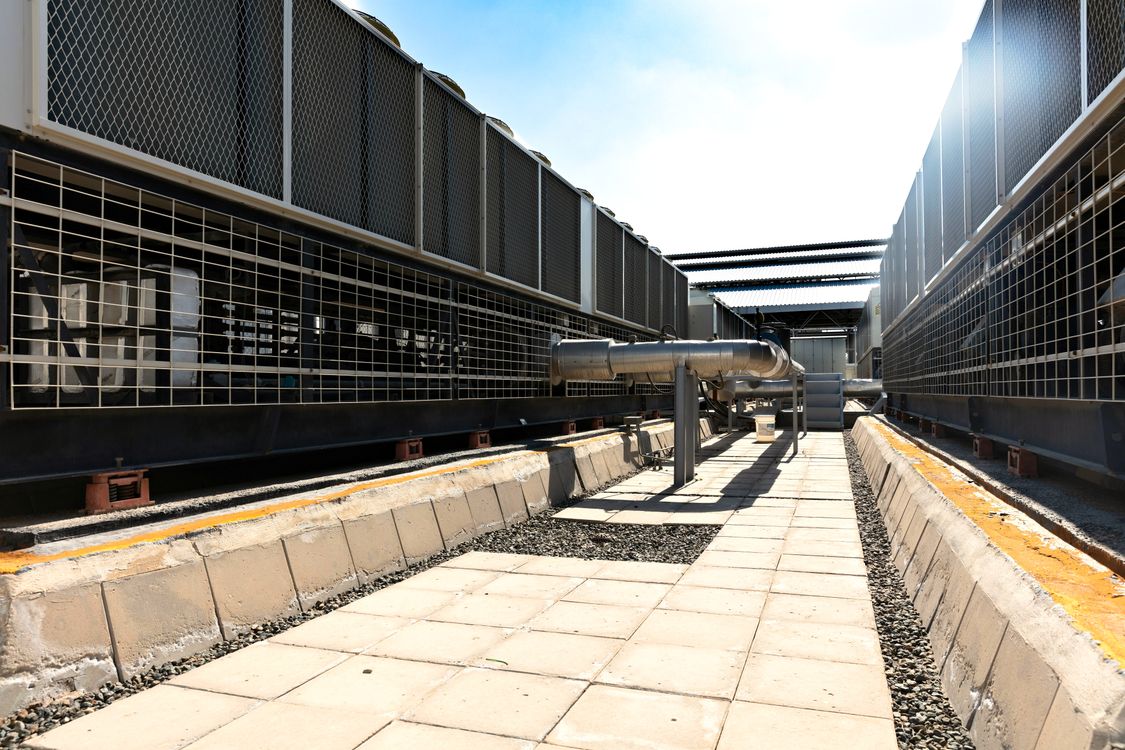
Cooling is the silent partner behind every profitable mining operation. While hash rate and electricity prices dominate the conversation, cooling infrastructure design determines whether an ASIC fleet runs at peak efficiency or throttles itself into unprofitability. A well-designed cooling system extends hardware life, reduces electricity waste, and enables higher density deployments that maximize revenue per square foot.
Whether you are building a modular data center from scratch or retrofitting a warehouse for ASIC miner hosting, understanding the engineering principles behind thermal management is critical. This guide covers airflow design, cooling system selection, environmental controls, and the economics that make or break a facility’s profitability.
Why Cooling Infrastructure Matters More Than You Think
Every watt an ASIC consumes becomes heat. A single Antminer S21 XP produces roughly 5,400 BTU per hour. At facility scale, a 1 MW deployment generates the thermal equivalent of heating a 50,000-square-foot building in winter — continuously. Without deliberate cooling design, ambient temperatures climb above the 35-40°C threshold where ASICs begin throttling, costing operators 5-15% of their hash rate and slashing ROI projections.
Cooling also directly affects hardware longevity. Operating ASICs above recommended temperatures accelerates capacitor aging and solder fatigue, reducing the useful lifecycle from 3-4 years down to 18-24 months. The cost difference between a poorly cooled facility and a well-designed one often exceeds $50,000 per megawatt per year in combined energy savings and deferred hardware replacement.
Cooling System Types for Mining Facilities
| Cooling Method | Capacity per MW | Installation Cost | Operating Cost | Best For |
|---|---|---|---|---|
| Forced-Air (Fans + Exhaust) | Moderate | $15,000 – $40,000 | Low | Dry climates, containers, warehouses |
| Evaporative (Swamp Coolers) | High | $25,000 – $60,000 | Very Low | Arid/semi-arid regions (under 40% RH) |
| Single-Phase Immersion | Very High | $80,000 – $150,000 | Moderate | High-density deployments, overclocking |
| Two-Phase Immersion | Extreme | $200,000 – $400,000 | Moderate-High | Maximum density, flagship facilities |
| Rear-Door Heat Exchangers | Moderate-High | $40,000 – $80,000 | Moderate | Traditional data centers, hybrid setups |
Most hosting providers including Rax Mining rely on forced-air cooling with carefully engineered airflow paths. This approach delivers the best balance of installation cost, operating cost, and maintainability for operations under 10 MW.
Airflow Design Fundamentals
Effective air cooling relies on three principles: intake separation, directed airflow, and exhaust management. Mining facilities borrow from traditional data center hot-aisle/cold-aisle design but adapt it for the much higher heat densities that ASIC miners produce.
Hot-Aisle/Cold-Aisle Configuration
The cold aisle faces the intake side of all miners, drawing fresh air from outside or from a plenum chamber. Miners exhaust into the hot aisle, where fans push the heated air out of the building. This prevents recirculation, the number-one airflow mistake that silently degrades performance across an entire facility.
For modular container deployments, the container itself functions as the airflow channel. Cold air enters one end, passes through a wall of miners, and exits as hot air from the opposite end. Properly sized exhaust fans create negative pressure that prevents hot air from recirculating.
Static Pressure and Fan Sizing
Undersized fans are the most common cooling mistake in DIY mining facilities. The key metric is cubic feet per minute (CFM) per kilowatt. For air-cooled ASIC deployments, target 150-200 CFM per kW of mining load. A 1 MW facility needs 150,000-200,000 CFM of total airflow capacity.
Industrial exhaust fans (48-inch or 54-inch diameter) typically deliver 20,000-30,000 CFM each. A 1 MW container facility needs 6-10 of these fans to maintain adequate airflow. Undersizing by even 20% can raise ambient temperatures by 8-12°C, pushing ASICs into thermal throttling territory during summer months.
Environmental Controls and Monitoring
Temperature is only half the equation. Humidity, dust, and altitude all affect cooling performance and hardware reliability. Professional mining facilities integrate environmental monitoring systems that track conditions in real time.
| Environmental Factor | Optimal Range | Risk if Exceeded | Mitigation |
|---|---|---|---|
| Temperature (intake) | 15 – 30°C | Throttling, premature failure | Fan sizing, evaporative cooling |
| Relative Humidity | 20 – 80% | Condensation or static discharge | Dehumidifiers, intake filters |
| Dust/Particulates | Minimal | Fan clogging, heat sink fouling | Intake filters, regular cleaning |
| Altitude (elevation) | Below 5,000 ft | Reduced air density = less cooling | Oversize fans by 3% per 1,000 ft |
Facilities in dusty or agricultural areas should install intake air filters rated MERV 8 or higher. While filters add static pressure (requiring slightly larger fans), they prevent the gradual buildup of debris on heat sinks that reduces cooling effectiveness by 10-20% over 6-12 months. Regular maintenance schedules should include filter replacement every 30-90 days depending on local conditions.
Cooling for Different Facility Types
Shipping Container Deployments
Standard 40-foot containers can house 200-300 ASIC miners when properly configured. The linear airflow path makes cooling straightforward: intake wall with filters on one end, exhaust fans on the other. Key design considerations include:
- Wall-mounted intake louvers with motorized dampers for temperature control
- Exhaust fan wall with 6-8 industrial fans for a fully loaded container
- Reflective exterior coating to reduce solar heat gain by up to 30%
- Insulation on roof and sun-facing wall to prevent radiant heat transfer
Container facilities at Rax Mining locations use this proven design pattern, delivering consistent cooling performance across varying climate conditions with minimal infrastructure cost.
Warehouse Conversions
Warehouses offer more flexibility but require more engineering. The large open floor plan means airflow must be actively managed with ductwork, curtains, or physical barriers to create defined hot and cold zones. Without containment, warm exhaust air mixes with intake air, raising average temperatures and reducing cooling effectiveness by 30-40%.
Purpose-Built Facilities
New construction allows designers to optimize every aspect of the cooling system from the ground up. Purpose-built mining facilities increasingly incorporate raised floors for cable management and air distribution, rooftop exhaust stacks sized for the full thermal load, and mechanical cooling backup systems that engage automatically if ambient temperatures exceed the evaporative cooling capacity.
Cooling Economics: The Numbers That Matter
Cooling typically represents 5-15% of a mining facility’s total power consumption. This overhead is expressed as the Power Usage Effectiveness (PUE) ratio, which measures total facility power divided by IT (mining) power.
| Cooling Approach | Typical PUE | Cooling Overhead per MW | Annual Cost at $0.075/kWh |
|---|---|---|---|
| Forced-air only | 1.05 – 1.10 | 50 – 100 kW | $24,000 – $48,000 |
| Evaporative + forced-air | 1.08 – 1.15 | 80 – 150 kW | $38,000 – $72,000 |
| Single-phase immersion | 1.02 – 1.05 | 20 – 50 kW | $9,600 – $24,000 |
| Traditional DX/chiller | 1.30 – 1.50 | 300 – 500 kW | $144,000 – $240,000 |
At wholesale power rates of $0.075/kWh, the difference between a PUE of 1.05 and 1.30 on a 1 MW deployment is over $100,000 per year. This makes cooling design one of the highest-leverage investments in mining facility economics. Use the Rax Mining profitability calculator to model how cooling costs affect your specific operation’s break-even timeline.
Seasonal Considerations and Climate Adaptation
Facilities in northern climates enjoy a natural cooling advantage during winter months, sometimes achieving PUE below 1.02 with fans alone. However, summer temperatures in states like Texas and Nebraska can push ambient air above 40°C, requiring supplemental cooling or operational adjustments.
Smart facility operators plan for worst-case cooling scenarios by designing their systems for the hottest expected conditions plus a safety margin. Demand response programs offer an additional hedge: curtailing mining during peak heat (which often coincides with peak electricity demand) can simultaneously reduce cooling load and earn grid service revenue.
Common Cooling Mistakes to Avoid
- Recirculation: Hot exhaust air feeding back into intake paths. Fix with physical containment or curtains.
- Undersized exhaust: Not enough CFM to move heat out of the building. Always oversize by 20%.
- Ignoring humidity: Condensation from evaporative coolers can damage electronics. Monitor RH continuously.
- No redundancy: A single fan failure should not cause facility-wide throttling. Build N+1 redundancy.
- Poor filtration: Dust buildup is gradual and invisible until performance drops 15-20%. Maintain filters proactively.
- Solar heat gain: Uninsulated metal roofs add significant thermal load. Reflective coatings pay for themselves in one summer.
Cooling and Hosted Mining: Why It Matters for Investors
If you are considering hosted ASIC mining rather than self-hosting, cooling infrastructure is one of the most important factors to evaluate in a colocation contract. Ask potential hosting providers about their PUE, airflow design, environmental monitoring, and maintenance schedules. A facility with a PUE of 1.08 versus 1.20 puts more of your electricity budget toward actual hash rate production.
Rax Mining facilities are engineered for optimal cooling at every location, with continuous monitoring and proactive maintenance that keeps your hardware running at peak efficiency year-round. Contact our team to learn more about our cooling infrastructure and hosting services.
{
“@context”: “https://schema.org”,
“@type”: “BlogPosting”,
“headline”: “Bitcoin Mining Cooling Infrastructure Design: Airflow, Systems, and Facility Engineering Guide”,
“description”: “Complete guide to designing cooling infrastructure for Bitcoin mining facilities: airflow engineering, system selection, environmental controls, PUE optimization, and seasonal adaptation strategies.”,
“author”: {“@type”: “Organization”, “name”: “Rax Mining”},
“publisher”: {“@type”: “Organization”, “name”: “Rax Mining”, “url”: “https://raxmining.com”},
“datePublished”: “2026-07-16”,
“dateModified”: “2026-07-16”,
“mainEntityOfPage”: {“@type”: “WebPage”}
}
Explore Rax Mining
- Bitcoin Miner Hosting — Competitive rates from $0.075/kWh
- NatGas MDU Units — 1MW modular datacenter containers
- Mining Profitability Calculator — Estimate your mining returns
- Our Facility — Tour our mining infrastructure