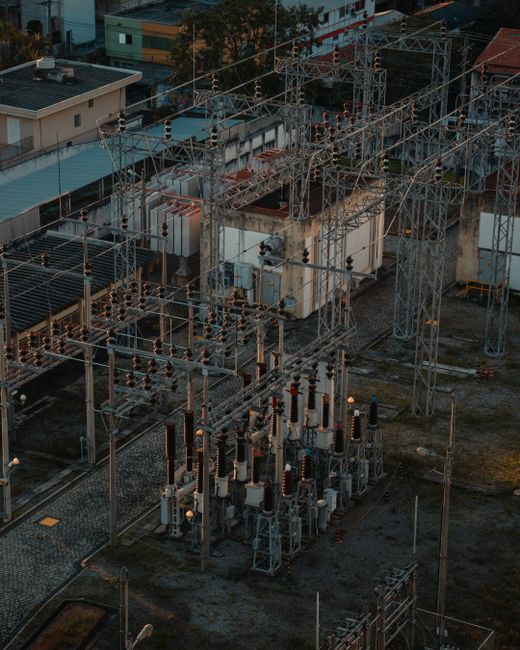
Electricity is the single largest operating cost in bitcoin mining, yet many operators underinvest in the electrical infrastructure that delivers it. Poor wiring, undersized breakers, and code violations don’t just waste money—they create fire hazards, void insurance policies, and cause costly downtime. Whether you’re building a 50-unit garage operation or a 5 MW colocation facility, getting the electrical foundation right determines everything that follows.
This guide covers the complete electrical stack from utility interconnection through the last outlet powering your ASIC miners, with practical sizing calculations, NEC code requirements, and cost benchmarks.
Understanding ASIC Power Requirements
Modern ASIC miners draw significant power at specific voltage and amperage combinations. Before designing any electrical system, you need to understand exactly what your fleet demands.
| ASIC Model | Power Draw (W) | Voltage | Amperage per Unit | Circuit Breaker (80% Rule) |
|---|---|---|---|---|
| Bitmain S21 | 3,500 | 220-240V | ~15.9A | 20A dedicated |
| Bitmain S21 Pro | 3,510 | 220-240V | ~16.0A | 20A dedicated |
| Bitmain S21 XP | 3,600 | 220-240V | ~16.4A | 20A dedicated |
| Bitmain T21 | 3,276 | 220-240V | ~14.9A | 20A shared (2 per 40A) |
| MicroBT M66S | 3,500 | 220-240V | ~15.9A | 20A dedicated |
| Bitmain S19 XP | 3,010 | 220-240V | ~13.7A | 20A shared (2 per 30A) |
The NEC 80% rule means a 20A breaker should carry no more than 16A continuous load. This is non-negotiable for mining operations running 24/7, which qualifies as continuous duty under NEC Article 210.
Utility Interconnection & Service Entrance
The electrical path starts at the utility meter. For mining operations, you’ll typically need three-phase power at 208V or 480V, stepped down to the 220-240V single-phase that most ASICs require.
Service Sizing by Fleet Size
| Fleet Size | Total Load (kW) | Recommended Service | Transformer Required | Estimated Electrical Install Cost |
|---|---|---|---|---|
| 10 ASICs | 35 | 200A single-phase 240V | No (residential panel) | $3,000 – $5,000 |
| 50 ASICs | 175 | 400A three-phase 208V | Yes (75 kVA) | $15,000 – $25,000 |
| 200 ASICs | 700 | 1,200A three-phase 480V | Yes (300 kVA step-down) | $60,000 – $100,000 |
| 500 ASICs | 1,750 | 2,500A three-phase 480V | Yes (750 kVA) | $150,000 – $250,000 |
| 1,000+ ASICs | 3,500+ | Dedicated substation | Multiple pad-mount | $400,000+ |
For operations above 200 units, professional colocation hosting is typically more cost-effective than building your own electrical infrastructure from scratch. Hosting providers like Rax Mining have already amortized transformer and switchgear costs across hundreds of clients.
Transformers: The Heart of Power Distribution
Transformers convert utility voltage to the levels your equipment needs. In mining, you’ll encounter two main configurations:
- Step-down from 480V to 208/240V: Most common in commercial facilities. 480V three-phase from the utility, stepped down to 208V three-phase or 240V single-phase at distribution panels.
- Pad-mount transformers: For larger operations (500+ kW), utility-owned pad-mount transformers deliver medium voltage (4.16kV or 12.47kV) directly to your site, stepped down on premises.
Transformer sizing should include 20% headroom above calculated load for future expansion and next-generation ASICs that may draw more power.
Power Distribution Units (PDUs)
PDUs sit between your main electrical panel and individual ASIC miners. They provide metered, switched, or managed power distribution with per-outlet monitoring.
PDU Types for Mining
| PDU Type | Features | Best For | Cost per Unit |
|---|---|---|---|
| Basic Rack PDU | Power strip with breaker | Small operations (<20 ASICs) | $100 – $300 |
| Metered PDU | Per-outlet power monitoring, LCD display | Mid-size operations tracking per-unit costs | $400 – $800 |
| Switched PDU | Remote on/off per outlet, IP management | Remote management needs | $800 – $1,500 |
| Managed PDU | SNMP, per-outlet metering + switching, alerts | Professional facilities, Tier II+ data centers | $1,200 – $2,500 |
For modular data center units (MDUs), PDUs are typically integrated into the container’s electrical system, pre-wired at the factory for plug-and-play deployment.
Wiring & Conductor Sizing
Undersized wiring creates voltage drop, wasted energy, and fire risk. NEC Article 310 dictates minimum conductor sizes based on amperage and distance.
Key Wiring Rules for Mining
- Voltage drop limit: NEC recommends no more than 3% voltage drop from panel to load (5% total from service entrance). At 240V, that’s 7.2V max panel-to-miner.
- Wire gauge: #12 AWG for 20A circuits, #10 AWG for 30A, #8 AWG for 40A, #6 AWG for 50A. For longer runs (>50 feet), upsize by one gauge.
- Conduit fill: NEC limits conduit fill to 40% for 3+ conductors. Overheated cables in overstuffed conduit cause ampacity derating.
- Copper vs. aluminum: Copper is standard for branch circuits. Aluminum feeders (properly terminated with anti-oxidant compound) save 40% on large conductor runs from main panel to sub-panels.
Breaker Panels & Switchgear
Your panel board is the nerve center of your electrical system. Mining operations need panels with adequate bus rating, space count, and proper labeling per NEC 408.4.
| Panel Component | Residential (1-10 ASICs) | Commercial (11-200 ASICs) | Industrial (200+ ASICs) |
|---|---|---|---|
| Main Panel | 200A load center | 400-800A panelboard | Switchgear with ATS |
| Sub-panels | None needed | 1 per 20-30 ASICs | Multiple switchboards |
| Breaker Type | Plug-on (Square D/Eaton) | Bolt-on commercial | Molded-case (MCCB) |
| Monitoring | Whole-panel meter | Per-circuit CT metering | SCADA integration |
| Surge Protection | Type 2 SPD | Type 1 + Type 2 SPD | Multi-stage SPD system |
NEC Code Compliance Essentials
Bitcoin mining facilities must comply with NEC (NFPA 70) and local electrical codes. Non-compliance risks:
- Voided insurance policies
- Failed inspections blocking operation
- Personal liability for fire damage
- Criminal charges in worst-case scenarios
Critical NEC Articles for Mining
- Article 210 (Branch Circuits): Continuous load = 80% breaker rating. 20A breaker = 16A max continuous.
- Article 220 (Load Calculations): Total connected load determines service size. Add 25% for largest motor load.
- Article 310 (Conductors): Ampacity tables for conductor sizing. Temperature correction factors for ambient temps above 86°F (common in mining).
- Article 408 (Switchboards/Panelboards): Labeling, clearances, and workspace requirements.
- Article 645 (IT Equipment): May apply to enclosed mining containers—allows disconnecting means and special wiring methods.
- Article 110.26: Working clearances—36" minimum in front of panels, 30" wide, headroom to ceiling or 6.5′.
Grounding & Bonding for Mining Facilities
Proper grounding protects against electrical shock and equipment damage from lightning or ground faults. Mining facilities need:
- Equipment grounding: Every ASIC chassis bonded to equipment grounding conductor back to panel
- Ground rods: Minimum two ground rods, 8 feet apart, driven to 8-foot depth
- Bonding: All metallic conduit, enclosures, and racking bonded per NEC 250
- Ground fault protection: GFPE required on services 1,000A or larger (NEC 230.95)
For facility security, grounding also serves as the foundation for lightning protection systems and surge suppression.
Electrical Safety & Maintenance
Mining operations run 24/7 with high current loads, creating unique safety considerations:
- Thermal imaging: Monthly infrared scans of breaker panels, connections, and PDUs catch hot spots before they become failures
- Torque checks: Verify terminal tightness annually—loose connections cause arcing and heat buildup
- Arc flash labels: NFPA 70E requires arc flash analysis and PPE labeling on all panels and switchgear
- Lockout/tagout: Written LOTO procedures for any maintenance involving live circuits
- Fire suppression: Clean agent (FM-200 or Novec 1230) systems for enclosed mining rooms or containers
Cost-Saving Electrical Strategies
Smart electrical design reduces both capital and operating costs:
- Run 240V, not 120V: Half the amperage = smaller wire, fewer circuits, less copper cost. All modern ASICs support 220-240V.
- Three-phase over single-phase: Better power factor, smaller conductors, reduced utility demand charges.
- Power factor correction: ASIC PSUs typically run 0.95+ PF, but facility-level correction capacitors prevent utility penalties.
- Aluminum feeders: 40% cheaper than copper for main feeders (properly terminated). NEC-approved for 4 AWG and larger.
- Bulk purchasing: Buy breakers, wire, and conduit in bulk. A 200-unit facility uses 200+ breakers—wholesale pricing saves 20-30%.
These strategies compound when combined with wholesale power rates and demand response programs.
When to Use Professional Hosting Instead
Building electrical infrastructure from scratch makes sense only at scale. For most miners, ASIC hosting with Rax Mining provides enterprise-grade electrical infrastructure without the capital expenditure:
- No transformer purchase or utility coordination (6-12 month lead times)
- No electrician costs ($75-$150/hour for commercial work)
- No permit and inspection delays
- Redundant power with automatic transfer switches and backup generators
- Professional monitoring, maintenance, and NEC compliance built in
Use our mining profitability calculator to compare self-hosted vs. colocation costs, including electrical infrastructure amortization, for your specific fleet size.
Frequently Asked Questions
What voltage do ASIC miners need?
Most modern ASIC miners (S21, T21, M66S) operate on 220-240V single-phase power. Running at 240V instead of 120V halves the amperage, allowing smaller wire and fewer circuits.
How many ASICs can I run on a 200A residential panel?
At 240V, a 200A panel provides 48 kW (200A × 240V). After the 80% continuous load derating and reserving capacity for household loads, you can typically run 8-10 ASIC miners (approximately 30-35 kW) on a residential service.
Do I need a licensed electrician?
Yes. NEC-compliant electrical work requires a licensed electrician in virtually all jurisdictions. DIY electrical work in mining operations voids insurance and creates serious fire and liability risk.
Explore Rax Mining
- Bitcoin Miner Hosting — Competitive rates from $0.075/kWh
- NatGas MDU Units — 1MW modular datacenter containers
- Mining Profitability Calculator — Estimate your mining returns
- Our Facility — Tour our mining infrastructure