Stranded Natural Gas to Bitcoin: The Arbitrage Opportunity Explained
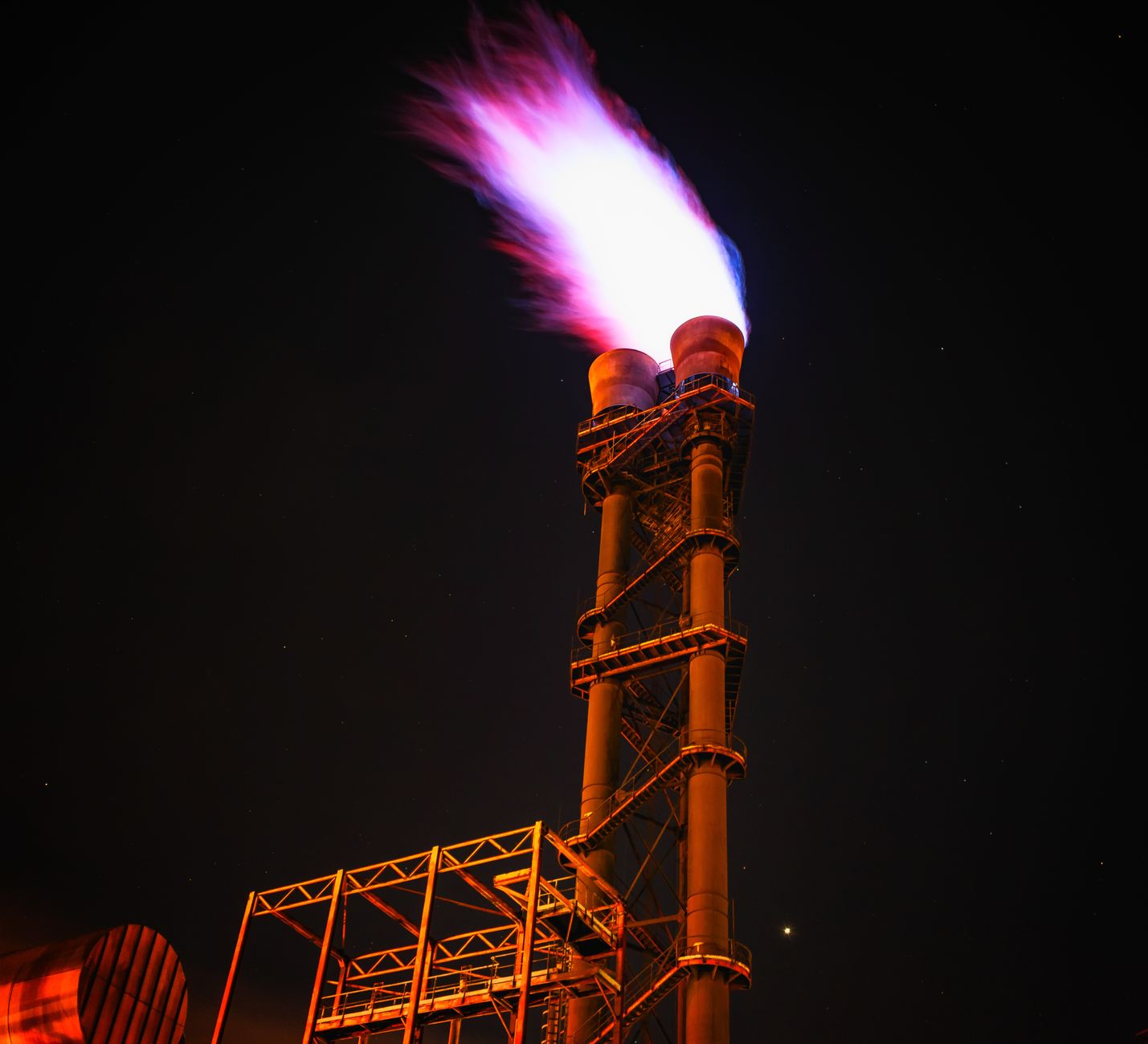
Every day, oil and gas wells across the United States produce natural gas that has no pipeline access, no local market, and no economic path to consumption. Historically, this gas was either vented directly into the atmosphere or flared — burned at the wellhead — because it was cheaper to destroy than to transport.
Bitcoin mining changed that equation entirely.
By deploying modular power generation and compute infrastructure directly at the wellhead, miners convert gas that would otherwise be wasted into electricity, and that electricity into Bitcoin. The result is an arbitrage opportunity that simultaneously generates revenue for miners, royalties for producers, and measurable reductions in greenhouse gas emissions.
This is not theoretical. As of 2026, natural gas is the single largest individual energy source powering the Bitcoin network at 38.2% of total electricity consumption, according to the Cambridge Centre for Alternative Finance. Companies like Crusoe Energy have deployed over 425 modular data centers across seven states, capturing nearly 22 billion cubic feet of gas that would have been flared.
What Is Stranded Natural Gas?
Natural gas is “stranded” when it is produced at a location where no infrastructure exists to bring it to market. This happens in three primary scenarios:
- Associated gas from oil production: When oil wells are drilled, natural gas often comes up as a byproduct. In prolific oil basins like the Permian, Bakken, and Eagle Ford, gas production can outpace pipeline capacity. The oil is the primary revenue stream. The gas is a logistical problem.
- Remote well locations: Natural gas deposits in areas far from existing pipeline networks face connection costs that exceed the value of the gas itself. Building a pipeline can cost $1 million to $5 million per mile. If the well is 50 miles from the nearest interconnect, the economics do not work.
- Temporary production: New well completions often produce gas at high volumes during the initial flowback period. This temporary gas surge may not justify permanent pipeline infrastructure, but it represents significant energy that can be monetized on-site.
The Waste Problem: Flaring and Venting
When stranded gas cannot be sold or used, operators have two options:
- Flaring: Burning the gas at the wellhead in a controlled flame. This converts methane (CH4) to carbon dioxide (CO2), which has roughly 80 times lower global warming potential over a 20-year period. Flaring is regulated but widely permitted as a safer alternative to venting.
- Venting: Releasing raw methane directly into the atmosphere. This is the worst outcome from an environmental perspective and is increasingly restricted by state and federal regulation, but it still occurs at wells with no flare infrastructure.
The scale of the problem is staggering. The World Bank estimates that global gas flaring exceeds 140 billion cubic meters per year — enough energy to power all of sub-Saharan Africa. In the United States alone, the Permian Basin flares billions of cubic feet of natural gas annually.
For oil producers, flaring is not a preference. It is a compliance obligation and a wasted resource. Every cubic foot of gas flared is revenue that was produced from the ground and then destroyed. Producers actively seek solutions that convert this waste stream into value.
The Arbitrage: From Waste Gas to Bitcoin
The economics of stranded gas Bitcoin mining work because of a fundamental imbalance: the cost of the gas at the wellhead is far below the value it can generate when converted to Bitcoin.
The Cost Side
Stranded natural gas at the wellhead has a local value close to zero — or in some cases, negative value, since the producer must pay to flare or dispose of it in compliance with regulations. When producers sell stranded gas to on-site mining operations, the price typically ranges from:
- $0.50 to $1.50 per MCF (thousand cubic feet) for stranded associated gas, compared to the Henry Hub benchmark of $2.00 to $4.00/MCF for pipeline-quality gas delivered to market.
Converting that gas to electricity through on-site generators produces power at approximately $0.02 to $0.04 per kWh — dramatically below grid rates and below even the most competitive commercial power purchase agreements.
The Revenue Side
At $0.03/kWh and current network conditions (mid-2026), the all-in cost to mine one Bitcoin using efficient hardware is approximately $30,000 to $35,000. With Bitcoin trading near $62,000, the margin per coin is $27,000 to $32,000 — a 45% to 50% gross margin on power and hardware costs.
This is the arbitrage: taking an energy source valued at near-zero at its point of production and converting it into a globally liquid digital asset worth $62,000 per unit.
Value Chain Comparison
| Scenario | Gas Value | Converted to Electricity | Mining Revenue (per MW/year) |
|---|---|---|---|
| Flared (wasted) | $0 | N/A | $0 |
| Sold at wellhead (rare) | $0.50–$1.50/MCF | N/A | $50K–$150K |
| On-site Bitcoin mining | $0.50–$1.50/MCF | $0.02–$0.04/kWh | $1.0M–$1.8M |
The revenue multiple from mining versus flaring is not incremental. It is transformative. A producer generating 1 MW worth of stranded gas can create $1 million or more in annual mining revenue from energy that was previously destroyed.
The Environmental Case
Bitcoin mining’s environmental narrative has historically been adversarial. Stranded gas mining inverts it.
Methane Reduction
When methane is vented, it enters the atmosphere as a potent greenhouse gas. When it is flared, combustion is often incomplete (flare efficiency ranges from 90% to 98%), meaning some methane escapes unburned. When that same gas is routed through a high-efficiency generator powering mining equipment, combustion efficiency reaches 99%+ and the exhaust is primarily CO2 and water vapor.
The net effect: stranded gas mining reduces emissions compared to both venting and flaring. It does not eliminate carbon output (natural gas combustion still produces CO2), but it converts the worst-case emission profile (raw methane release) into the best-case scenario for that gas (complete combustion in a high-efficiency engine).
Measurable Impact
Crusoe Energy — the largest stranded gas mining operator — reported mitigating 2.7 million metric tons of CO2-equivalent emissions through its operations. In 2024 alone, the company captured 10 billion cubic feet of gas and converted it to 1.3 TWh of electricity for computing operations.
This is not greenwashing. It is measurable, third-party verifiable emissions reduction driven by economic incentive. Producers reduce their flaring obligations and earn revenue. Miners access below-market power. The atmosphere receives less methane. Everyone wins.
The Infrastructure: How It Works in Practice
A stranded gas mining deployment consists of four primary components:
1. Gas Capture and Treatment
Raw wellhead gas often contains impurities (water vapor, H2S, heavier hydrocarbons) that must be removed before it can fuel generators. Gas treatment equipment — separators, scrubbers, and dehydration units — conditions the gas to generator specifications. This equipment is typically compact and field-deployable.
2. On-Site Power Generation
Natural gas generators convert the treated gas to electricity. Common configurations include reciprocating engines (Caterpillar, Waukesha, Jenbacher) or microturbines, sized to match available gas volume. A typical deployment uses multiple generator sets for redundancy — if one unit goes down for maintenance, the others continue operating.
3. Electrical Distribution
Switchgear, transformers, and distribution panels deliver generator output to the mining containers at the correct voltage and amperage. Modern deployments use 415/240V or 480/277V three-phase power with multiple 600A panels.
4. Computing Infrastructure
Containerized mining units house the ASIC hardware, cooling systems, and network connectivity. These are purpose-built for field deployment — ruggedized, weather-resistant, and designed to operate in remote locations with minimal local infrastructure.
The entire system — from gas inlet to hashing output — can be deployed and commissioned in as little as 60 days using pre-fabricated modular components.
The NatGas MDU: Purpose-Built for This Opportunity
The NatGas MDU (Modular Datacenter Unit) is the infrastructure solution designed specifically for natural gas mining deployments. Each unit delivers:
- 1 MW of compute capacity in a standard 40-foot Conex container
- Three 350 kW natural gas generator sets providing redundant on-site power
- Integrated cooling (air-cooled and hydro-cooled options)
- Electrical distribution (415/240V or 480/277V, 3x 600A panels)
- Starlink satellite connectivity for remote locations without fiber
- Turnkey operations including 24/7 on-site staff, construction, and integration
At $600,000 per MW unit, the NatGas MDU provides the infrastructure backbone for stranded gas deployments at a fraction of the cost of permanent construction. Units are fully portable and re-deployable, meaning they can follow gas production as wells mature and new sites come online.
For operators deploying at scale, units can be stacked from 1 MW to 30 MW at a single site, with each container operating independently while sharing common gas supply infrastructure.
Site Economics: A Worked Example
Consider a hypothetical 5 MW stranded gas mining deployment in the Permian Basin:
| Line Item | Value |
|---|---|
| Infrastructure (5x NatGas MDU) | $3,000,000 |
| ASIC hardware (~1,370 S21 XP units) | $8,220,000 |
| Total capital deployment | $11,220,000 |
| Power rate (stranded gas) | $0.035/kWh |
| Annual electricity cost (95% uptime) | $1,458,900 |
| Annual operations overhead | $480,000 |
| Estimated annual BTC mined | ~38 BTC |
| Estimated annual gross revenue (at $62K/BTC) | $2,356,000 |
| Estimated annual net operating income | $417,100 |
Assumptions: 900 EH/s network hashrate, 3.125 BTC block reward, S21 XP (270 TH/s, 3.645 kW), 95% uptime, $62,000 BTC. Excludes pool fees (~1-2%), firmware costs, and potential BTC price appreciation. Numbers are illustrative estimates.
At these economics, the infrastructure payback period on the NatGas MDU containers alone is under 8 years, with the full deployment (hardware included) achieving payback faster if Bitcoin price appreciates or difficulty decreases. Critically, the miner also accumulates BTC throughout the operating period — an asset that has historically appreciated over multi-year horizons.
Regulatory Landscape
Stranded gas mining operates at the intersection of energy regulation, environmental compliance, and cryptocurrency oversight. Key considerations:
- State flaring regulations: Texas, New Mexico, North Dakota, and other producing states are tightening flaring allowances. On-site monetization through mining provides a compliance pathway that reduces flaring volumes.
- EPA methane rules: Federal methane emission regulations under the Inflation Reduction Act impose financial penalties on excess methane emissions. Mining operations that capture and combust gas at high efficiency can help producers avoid these penalties.
- Carbon credit eligibility: Some stranded gas mining operations have qualified for voluntary carbon credits based on measurable emissions reductions. This creates an additional revenue stream beyond Bitcoin mining itself.
- Noise and land use: Remote wellsite locations typically face minimal noise or zoning restrictions, but operators should verify local ordinances before deployment.
Risks and Considerations
Stranded gas mining is not without risk:
- Gas supply variability: Well production declines over time. A site producing 2 MW worth of gas today may produce 1 MW in two years. Modular, portable infrastructure mitigates this — move units to new wells as old ones decline.
- Remote operations: Wellsite locations are often remote, with limited road access, no grid power, and extreme weather exposure. Operations and logistics costs are higher than urban or suburban hosting.
- Bitcoin price risk: Like all mining, profitability is tied to Bitcoin price. Sub-$0.04/kWh power provides a substantial cushion against price declines, but extended bear markets can still compress margins.
- Regulatory change: Future regulations could restrict on-site combustion or impose new permitting requirements on wellsite computing operations.
Bottom Line
Stranded natural gas Bitcoin mining is the rare case where economic self-interest and environmental benefit align perfectly. The gas exists. It is being wasted. Converting it to Bitcoin generates revenue for producers and miners while reducing the most harmful form of emissions (unburned methane venting).
The infrastructure to capture this opportunity is available, proven, and deployable in weeks. The arbitrage window exists as long as stranded gas has no better path to market than on-site power generation — and given the structural pipeline constraints in major producing basins, that window is measured in decades, not months.
Deploy Mining Infrastructure at Your Wellsite
Rax Mining’s NatGas MDU delivers 1 MW of turnkey mining capacity with integrated natural gas power generation. Purpose-built for wellsite and stranded gas deployments with 60-day commissioning. Explore buy-and-host bundles for a complete hardware and infrastructure solution.
Call 718-766-8559 or email info@rax.ae to discuss site evaluation and capacity planning.
Explore Rax Mining
- Bitcoin Miner Hosting — Competitive rates from $0.075/kWh
- NatGas MDU Units — 1MW modular datacenter containers
- Mining Profitability Calculator — Estimate your mining returns
- Our Facility — Tour our mining infrastructure