A single compromised mining controller can redirect hundreds of terahashes to an attacker’s pool address in seconds. Unlike traditional IT infrastructure where breaches cost data, a mining operation breach costs real-time revenue — every hash diverted is Bitcoin lost. As mining operations grow in scale and sophistication, cybersecurity is no longer optional. It is a direct profitability concern.
This guide covers the specific cybersecurity threats facing Bitcoin mining operations and the practical countermeasures that protect your hashrate, your infrastructure, and your revenue.
Why Mining Operations Are High-Value Targets
Bitcoin mining facilities present a uniquely attractive attack surface for several reasons. First, the output is directly monetizable — unlike stealing customer data that must be sold on dark markets, redirected hashrate produces Bitcoin immediately. Second, mining infrastructure often prioritizes uptime and performance over security, leaving exploitable gaps. Third, many mining operations run on flat networks with minimal segmentation, meaning a single compromised device can provide access to an entire fleet.
The financial impact is substantial. A 10 PH/s operation at current hashprice (~$32/PH/day) generates roughly $320 per day. If an attacker silently redirects pool credentials across a fleet, the operator may not notice for days or weeks — especially if the attacker only skims a percentage of blocks rather than redirecting everything at once.
The Five Primary Threat Vectors
1. Pool Hijacking and Stratum Credential Theft
The most direct attack against mining revenue is pool hijacking — modifying the Stratum pool URL or wallet address configured on ASIC miners so that hashrate flows to an attacker-controlled pool account. This can occur through:
- Compromised management interfaces: ASIC web UIs (Antminer, Whatsminer, Avalon) accessible without authentication or with default credentials
- Man-in-the-middle (MITM) attacks: Intercepting unencrypted Stratum V1 traffic on local networks to modify pool configurations
- Malicious firmware: Modified firmware images that include hardcoded attacker pool addresses alongside or replacing the operator’s configuration
- DNS poisoning: Redirecting pool domain resolution to attacker-controlled servers
Countermeasures: Change all default ASIC passwords before deployment. Use Stratum V2 where supported (encrypted, authenticated connections). Monitor pool-reported hashrate against expected fleet output — discrepancies beyond 3-5% warrant immediate investigation. Pin DNS to trusted resolvers (not DHCP-assigned) and consider DNS-over-HTTPS for management networks.
2. Firmware Supply Chain Attacks
Custom firmware (BraiinsOS+, LuxOS, VNish) can improve efficiency by 10-25%, but every firmware flash is a trust decision. Compromised firmware can include:
- Hidden dev-fee addresses that skim 1-5% of hashrate
- Backdoor SSH access with hardcoded credentials
- Keyloggers that capture pool credentials entered through the web UI
- Kill switches that can brick machines remotely
Countermeasures: Only download firmware from official vendor sources. Verify SHA256 checksums against published values before flashing. Flash a test unit first and monitor its network traffic for unexpected outbound connections for 48-72 hours before fleet-wide deployment. Maintain a known-good firmware image for emergency rollback.
3. Network-Level Intrusions
Flat network architectures — where management workstations, ASIC miners, security cameras, and internet-connected devices share the same subnet — allow an attacker who compromises any single device to access everything. Common entry points include:
- Unpatched network switches with default SNMP community strings
- IoT devices (temperature sensors, smart PDUs) with known vulnerabilities
- Remote access tools (TeamViewer, AnyDesk) with weak credentials
- Exposed management ports (SSH, HTTP) accessible from the internet
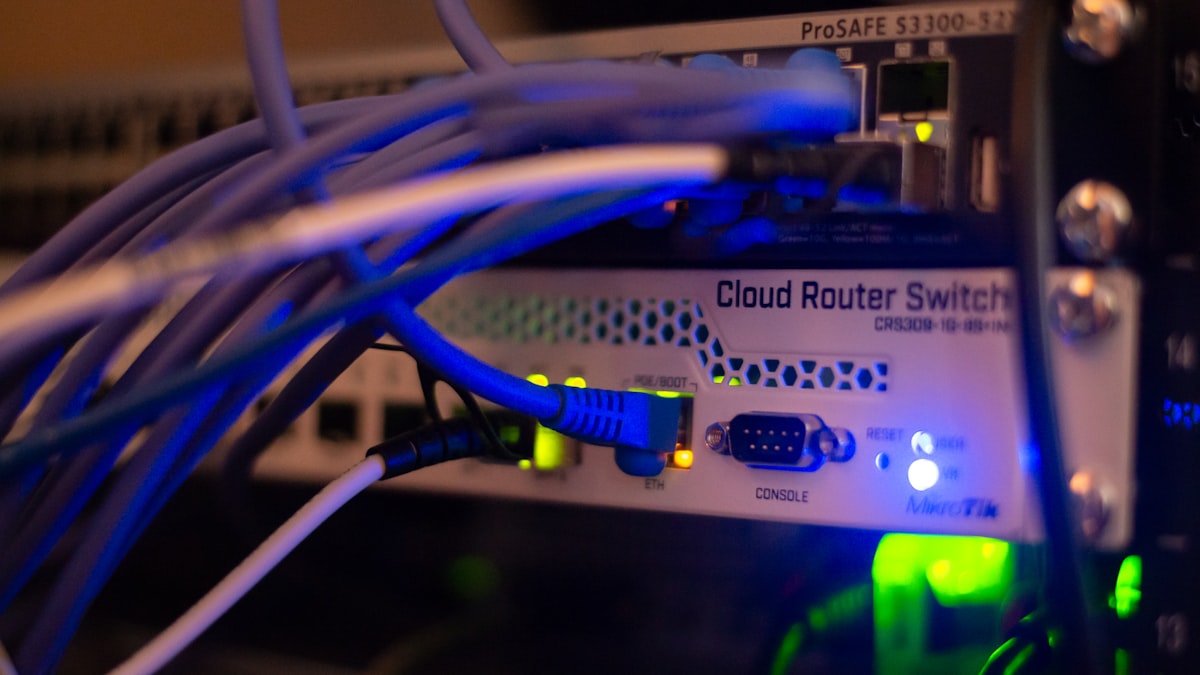
Countermeasures: Implement VLAN segmentation (detailed below). Disable UPnP on all network devices. Use a hardware firewall at the network perimeter. Restrict outbound traffic to only the ports and destinations required for Stratum connections and firmware updates.
4. Physical Access Exploits
Physical access to mining hardware often means unrestricted access to configuration. An attacker or malicious insider with physical access to an ASIC miner can:
- Connect via serial/UART console to bypass authentication
- Reset firmware to factory defaults and reconfigure pool settings
- Install a rogue network device (e.g., a Raspberry Pi) on the mining network
- Clone SD cards containing wallet configurations
Countermeasures: Physical security controls (covered in our hosting security guide) are the first line of defense. Implement 802.1X port-based network access control so unknown devices cannot join the network. Use tamper-evident seals on ASIC control boards. Log and alert on new MAC addresses appearing on mining VLANs.
5. Ransomware and Operational Disruption
While ransomware typically targets data, mining operations face a variant: attackers who compromise management systems can threaten to brick firmware across an entire fleet, demand payment to restore pool configurations, or simply shut down operations during high-profitability periods.
Countermeasures: Maintain offline backups of all ASIC configurations (pool URLs, fan profiles, frequency settings). Keep management systems (Foreman, Awesome Miner, Hive OS) on a separate, hardened network segment. Implement role-based access control on all management platforms. Test restoration procedures quarterly.
Network Architecture: The VLAN Segmentation Blueprint
Proper network segmentation is the single most impactful cybersecurity measure for mining operations. A well-segmented network limits blast radius — even if one segment is compromised, the attacker cannot pivot to others.
Recommended VLAN Structure
VLAN 10 — Management Network: Management workstations, monitoring servers (Foreman/Awesome Miner), and out-of-band management interfaces. This VLAN has internet access for monitoring dashboards and alerting.
VLAN 20 — Mining Fleet (Row/Pod A): ASIC miners in the first physical zone. Outbound access restricted to Stratum ports (3333, 443) to whitelisted pool IP addresses only. No inbound access except from VLAN 10 management hosts.
VLAN 30 — Mining Fleet (Row/Pod B): Second physical zone. Same firewall rules as VLAN 20. Separating rows limits the scope of any single-VLAN compromise.
VLAN 40 — Infrastructure/IoT: Environmental sensors, smart PDUs, UPS management cards, security cameras. Isolated from mining and management VLANs. No internet access except for specific NTP and alerting endpoints.
VLAN 50 — Guest/Visitor: Isolated network for visitor devices, contractor laptops. No access to any other VLAN.
Inter-VLAN routing rules should follow the principle of least privilege. Mining VLANs should not be able to communicate with each other. Only the management VLAN should reach mining fleet VLANs, and only on specific ports (SSH 22, HTTP 80/443 for ASIC web UIs, and SNMP 161 if used for monitoring).
SSH Hardening for Mining Infrastructure
SSH is the primary remote access protocol for ASIC miners and management servers. Default configurations are dangerously permissive.
Essential SSH Hardening Steps
- Disable password authentication: Use key-based authentication exclusively. Generate ED25519 keys (stronger than RSA) for each authorized operator.
- Change the default port: Move SSH from port 22 to a non-standard port (e.g., 2222 or higher). This eliminates automated scanning noise.
- Restrict access by source IP: Use firewall rules to allow SSH connections only from the management VLAN or specific jump hosts.
- Disable root login: Force operators to authenticate as individual users, then escalate privileges via sudo. This creates an audit trail.
- Implement fail2ban: Automatically block IP addresses after 3-5 failed login attempts. Mining infrastructure sees constant SSH brute-force attempts from botnets.
- Session timeouts: Set ClientAliveInterval and ClientAliveCountMax to terminate idle SSH sessions after 15 minutes.
Monitoring and Detection: Knowing When Something Is Wrong
Detection speed directly determines financial impact. A pool hijack caught in 30 minutes costs one miner-hour of revenue. The same hijack running undetected for a week costs 168 times more.
Critical Monitoring Points
Hashrate deviation alerts: Compare pool-reported hashrate to expected fleet output every 5 minutes. Alert if deviation exceeds 5%. This catches both hardware failures and pool hijacking simultaneously.
Configuration change detection: Monitor ASIC miner configurations (pool URL, wallet address, worker name) via API polling. Any unauthorized change should trigger an immediate alert and automatic rollback if possible.
Network traffic anomaly detection: Mining traffic follows predictable patterns — Stratum connections to known pool IPs on known ports. Any outbound connection to an unknown IP or port is suspicious. Tools like Zeek (formerly Bro) or Suricata can analyze mining network traffic at line rate.
Authentication log monitoring: Aggregate SSH, web UI, and management platform login attempts. Failed login bursts, successful logins from unusual IPs, or logins outside business hours should generate alerts.
DNS query logging: Log all DNS queries from mining VLANs. Miners should only resolve pool domains. Queries to unknown domains may indicate malware or C2 communication.
Incident Response Plan for Mining Operations
Every mining operation needs a documented incident response plan. When a security event occurs, the response must be fast, structured, and practiced.
Phase 1: Detection and Triage (0-15 minutes)
Confirm the incident is real (not a false alarm). Classify severity: revenue-impacting (pool hijack, ransomware) vs. reconnaissance (port scanning, failed logins). Notify the on-call security contact.
Phase 2: Containment (15-60 minutes)
Isolate affected network segments. If pool hijacking is confirmed, immediately reconfigure affected miners to a known-good pool configuration. If malware is suspected, disconnect the compromised management system from the network but do not power it off (preserve forensic evidence).
Phase 3: Eradication and Recovery (1-24 hours)
Identify the attack vector. Reflash compromised ASIC firmware from verified images. Reset all credentials (ASIC passwords, SSH keys, management platform passwords, pool account API keys). Verify network segmentation is intact.
Phase 4: Post-Incident Review (24-72 hours)
Document the timeline, attack vector, impact (hashrate-hours lost, BTC value), and response effectiveness. Update firewall rules, monitoring alerts, and access controls based on lessons learned. Share findings with your hosting provider if applicable.
Securing Remote Management Access
Many mining operators manage facilities remotely, which creates additional attack surface. Secure remote access requires layered controls.
VPN-only access: Never expose ASIC web UIs, management platforms, or SSH directly to the internet. Route all remote access through a VPN concentrator with multi-factor authentication (MFA). WireGuard offers excellent performance with modern cryptography.
Jump host architecture: Place a single hardened jump host (bastion) in the management VLAN. Remote operators VPN in, SSH to the jump host, then SSH to individual miners or management systems from there. This creates a single audit point and limits lateral movement.
Session recording: Record all remote management sessions for audit purposes. Tools like Teleport or OpenSSH session logging provide full session replay capability. This deters insider threats and aids incident investigation.
Cybersecurity Checklist for Mining Operators
- Change all default passwords on ASIC miners before rack deployment
- Implement VLAN segmentation separating management, mining, and IoT networks
- Use key-based SSH authentication with ED25519 keys
- Whitelist outbound connections from mining VLANs to known pool IPs only
- Enable fail2ban on all SSH-accessible devices
- Monitor pool-reported hashrate vs. expected fleet output (alert at 5% deviation)
- Poll and log ASIC miner configurations every 15 minutes
- Verify firmware checksums before flashing
- Require VPN + MFA for all remote management access
- Maintain offline backups of all ASIC configurations
- Test incident response procedures quarterly
- Review and rotate credentials on a 90-day cycle
The Cost of Ignoring Cybersecurity
The economics are straightforward. A 50 PH/s operation at $32/PH/day generates $1,600 daily. A week-long undetected pool hijack costs $11,200 in lost revenue. A fleet-wide firmware attack that requires reflashing 500 miners costs 40-80 hours of technician time plus the downtime revenue loss. Compare this to the cost of proper segmentation (a managed switch and a few hours of configuration) and monitoring (open-source tools plus alerting setup).
Cybersecurity investment in mining operations has one of the highest ROI profiles of any operational expense. The question is not whether you can afford to implement it — it is whether you can afford not to.
How Rax Mining Protects Hosted Operations
Rax Mining hosting facilities implement enterprise-grade network security including VLAN segmentation, 24/7 monitoring, and hardened remote access infrastructure. Our consulting team can also assess your self-hosted operation’s security posture and recommend improvements tailored to your scale and budget. Browse our ASIC inventory for miners ready to deploy in secured hosting environments, or explore our NatGas MDU deployments with integrated security infrastructure.
As mining operations increasingly add AI data center capacity alongside their mining infrastructure, cybersecurity requirements expand significantly. Learn more in our guide to how mining companies are building AI data center revenue streams.
Frequently Asked Questions
What is the most common cyberattack on Bitcoin mining operations?
Pool hijacking — modifying the Stratum pool URL or wallet address on ASIC miners to redirect hashrate to an attacker-controlled account. This is the most common attack because it directly monetizes the compromise and can go undetected if operators do not monitor pool-reported hashrate against expected fleet output.
How does VLAN segmentation protect a mining facility?
VLAN segmentation divides the network into isolated zones (management, mining fleet, IoT, guest). If an attacker compromises a device in one VLAN, they cannot pivot to other segments. This limits the blast radius of any security incident and protects high-value management systems from being accessed through lower-security IoT devices.
Should Bitcoin miners use Stratum V2?
Yes, where hardware and pool support exist. Stratum V2 encrypts the connection between the miner and the pool, preventing man-in-the-middle attacks that could modify pool configurations in transit. It also allows miners to construct their own block templates, improving decentralization. Adoption is growing but not yet universal across all ASIC models and pools.
How often should mining operations audit their cybersecurity posture?
Quarterly at minimum. Review access controls, credential hygiene, firewall rules, and monitoring alert effectiveness. Conduct a full penetration test annually if the operation exceeds 10 MW. After any security incident, perform an immediate audit of all controls.
What is the cost of implementing cybersecurity for a small mining operation?
A basic security setup for a sub-1 MW operation (managed switch with VLAN support, firewall, fail2ban, hashrate monitoring scripts) costs $500-$2,000 in hardware and 8-16 hours of configuration time. This protects against the most common attack vectors and provides detection capability for advanced threats. Larger operations should budget $5,000-$20,000 annually for dedicated security tooling and periodic audits.
Secure Your Mining Operation with Professional Infrastructure
Rax Mining provides enterprise-grade colocation hosting with network-segmented infrastructure, 24/7 monitoring, and physical security across 27 US facilities. Our managed hosting removes the burden of building and securing your own network infrastructure. Explore our ASIC hardware options or contact us to discuss secure hosting for your fleet.
Explore Rax Mining
- Bitcoin Miner Hosting — Competitive rates from $0.075/kWh
- NatGas MDU Units — 1MW modular datacenter containers
- Mining Profitability Calculator — Estimate your mining returns
- Our Facility — Tour our mining infrastructure