Why Air Cooling Still Dominates Bitcoin Mining: A Cost-Per-Terahash Comparison with Immersion and Hydro Cooling for Hosted Operations
The Bitcoin mining industry has been buzzing about advanced cooling technologies for years. Immersion cooling, hydro cooling, and hybrid systems promise lower temperatures, quieter operations, and extended ASIC lifespans. Yet as of late 2026, traditional air cooling remains the dominant deployment method across hosted mining facilities worldwide. The reason is straightforward: when you break down the total cost per terahash over a typical hosting contract, air cooling delivers the most predictable economics for the majority of miners.
This analysis compares the three primary cooling methods used in Bitcoin mining colocation today, examining capital expenditure, operating costs, maintenance complexity, and hosting rate implications to help miners make informed infrastructure decisions.
Understanding the Three Cooling Methods
Forced Air Cooling
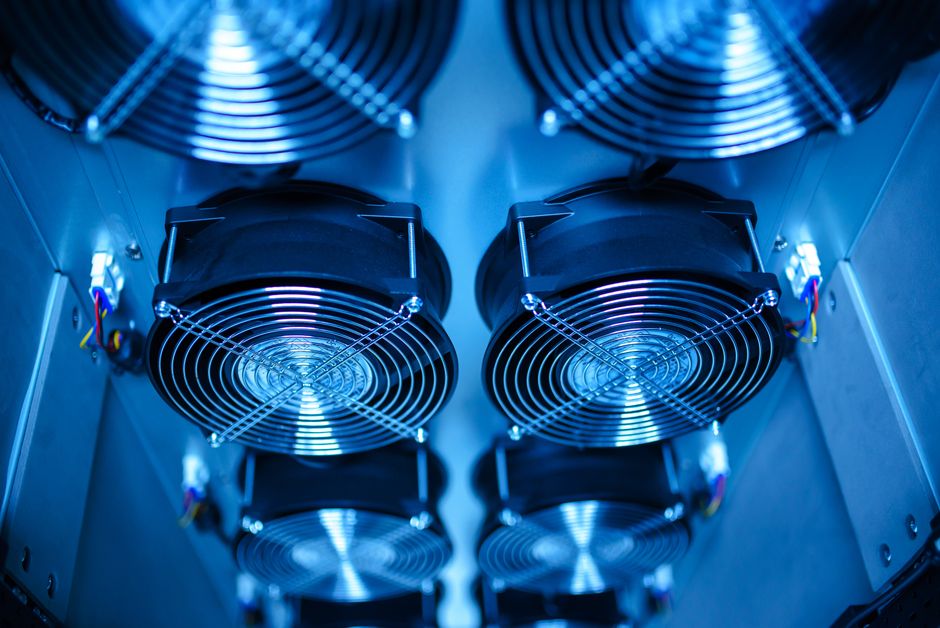
Forced air cooling uses industrial fans and engineered airflow pathways to move ambient or conditioned air across ASIC hash boards. Hot aisle/cold aisle configurations, exhaust ductwork, and evaporative pre-cooling are common enhancements. The vast majority of Bitcoin mining facilities — from converted warehouses to purpose-built natural gas MDU deployments — use some form of forced air cooling.
Capital costs for air-cooled infrastructure typically range from $80 to $150 per kilowatt of IT load, depending on climate zone and whether evaporative assist is included. Maintenance is straightforward: filter replacement, fan motor servicing, and periodic duct cleaning. Any qualified HVAC technician can service the equipment.
Single-Phase Immersion Cooling
Single-phase immersion submerges ASIC miners in a tank of dielectric fluid (typically engineered mineral oil or synthetic coolant). Heat transfers from the components to the fluid, which is then circulated through a heat exchanger. The technology eliminates fans entirely and can reduce operating temperatures by 15-25°C compared to air cooling.
Capital costs are substantially higher: $300 to $600 per kilowatt when accounting for immersion tanks, fluid inventory, circulation pumps, heat exchangers, and fluid management systems. The dielectric fluid itself represents a significant expense, typically $3,000 to $8,000 per tank depending on capacity and fluid type.
Rear-Door and Hydro Cooling
Hydro cooling (also called direct liquid cooling or rear-door heat exchangers) uses water or water-glycol loops attached to ASIC miners via cold plates or rear-door coils. This approach captures heat more efficiently than air but without fully submerging equipment. Several next-generation ASIC designs from Bitmain and competitors include factory liquid cooling options.
Capital costs fall between air and immersion, typically $200 to $400 per kilowatt, with the added requirement of water treatment systems, leak detection infrastructure, and corrosion-resistant plumbing.
Total Cost of Ownership Over a 24-Month Hosting Contract
For a representative deployment of 100 Antminer S21 units (195 TH/s each, 3,500W), here is how costs break down across cooling methods over a standard 24-month hosted mining contract at current market rates:
Infrastructure Capital Per Megawatt
Air cooling infrastructure for a 350 kW deployment (100 S21 units) typically requires $28,000 to $52,500 in cooling infrastructure. Immersion cooling for the same load requires $105,000 to $210,000 in tanks, fluid, pumps, and exchangers. Hydro cooling falls in the $70,000 to $140,000 range. These are facility-side costs that hosting providers amortize into their per-kilowatt-hour rates.
Impact on Hosting Rates
The higher capital cost of advanced cooling directly impacts what hosting providers charge. Air-cooled facilities can profitably offer rates in the $0.055 to $0.075 per kWh range — the standard tier structure at Rax Mining’s colocation services. Immersion-cooled facilities typically add $0.005 to $0.015 per kWh to cover fluid costs, specialized maintenance, and slower capital recovery.
Over 24 months of continuous operation, that $0.01/kWh premium on a 350 kW deployment adds approximately $61,320 in additional hosting costs. The question becomes whether immersion cooling’s benefits — lower chip temperatures, potential overclocking headroom, and reduced fan failures — justify that premium.
Operational Advantages of Each Method
Air Cooling Strengths
Simplicity is air cooling’s greatest advantage. Equipment can be deployed, serviced, and replaced quickly. When an ASIC fails, a technician pulls it from the rack and swaps it in minutes. Spare parts are universally available. The operational knowledge base is enormous — every mining facility technician understands air cooling.
Air-cooled facilities also offer maximum flexibility for hardware changes. As new ASIC generations launch, air-cooled miners can be swapped out with zero infrastructure modification. This matters for miners who plan to upgrade from current-gen S21 series units to next-generation hardware within their hosting contract.
Immersion Cooling Strengths
Immersion cooling excels in extreme heat environments and noise-sensitive locations. For mining operations in the Middle East, equatorial regions, or near residential areas, immersion eliminates both the thermal challenge and the acoustic footprint. Chip temperatures 15-25°C lower can extend ASIC lifespan and may allow modest overclocking (typically 5-15% additional hashrate without proportional power increase).
Immersion also eliminates airborne dust and particulate exposure, which is valuable in desert, agricultural, or industrial environments where air filtration is a constant maintenance burden.
Hydro Cooling Strengths
Hydro cooling offers a middle ground: better heat removal than air with lower complexity than full immersion. Factory-integrated liquid cooling on next-gen ASICs may eventually make this the default, but as of late 2026, the retrofit market for existing hardware is still maturing.
Maintenance Complexity and Hidden Costs
One factor often underestimated in cooling comparisons is maintenance complexity. Air cooling maintenance is routine HVAC work. Immersion cooling requires specialized knowledge: fluid quality monitoring, viscosity testing, leak remediation procedures, and proper ASIC extraction protocols for servicing submerged equipment.
When an immersion-cooled ASIC needs hash board repair, it must be extracted from the tank, allowed to drain (dielectric fluid has significant surface tension), cleaned, repaired, and resubmerged. This process takes 2-4 hours per unit versus 15-30 minutes for air-cooled rack servicing. For a large deployment, the cumulative maintenance labor difference is substantial.
Fluid degradation is another hidden cost. Dielectric fluids degrade over time through thermal cycling and may need partial or full replacement every 18-36 months, depending on operating conditions and fluid chemistry. Budget $1,500 to $4,000 per tank for fluid refresh cycles.
When Advanced Cooling Makes Economic Sense
Despite air cooling’s overall cost advantage, specific scenarios favor immersion or hydro cooling:
High ambient temperature locations: Facilities in regions where ambient temperatures regularly exceed 40°C (104°F) may find that the air cooling premium (larger fans, evaporative systems, higher electricity for cooling) approaches or exceeds the immersion cost premium.
Noise-restricted sites: Urban or suburban mining operations where noise ordinances limit fan-based cooling may require immersion as a regulatory compliance measure, making it a necessity rather than a choice.
Overclocking-focused strategies: Miners who actively overclock their ASIC fleet and need the thermal headroom to sustain elevated hash rates may recover the immersion premium through additional Bitcoin earned per unit.
Premium colocation positioning: Hosting providers who want to differentiate on service quality and attract high-value, long-term contracts may invest in immersion to justify premium rates and reduce churn.
The Natural Gas MDU Advantage
For natural gas-powered mobile data units, air cooling is the standard configuration and delivers compelling economics. MDU deployments benefit from controlled environments purpose-built for Bitcoin mining, with engineered airflow, filtration, and environmental controls integrated into the container design.
At Rax Mining’s standard hosting rate of $0.075/kWh, air-cooled MDU deployments offer some of the lowest cost-per-terahash hosting available in the market. The combination of low-cost natural gas generation and efficient air cooling creates a cost structure that immersion cooling cannot match for most use cases.
For miners exploring colocation options, the Rax Mining profitability calculator helps model returns under different hosting rate and hardware configurations.
Looking Ahead: Factory Liquid Cooling and Next-Gen ASICs
The cooling landscape is evolving. Bitmain’s next-generation ASIC designs increasingly include factory liquid cooling options. If liquid cooling becomes the manufacturer default rather than an aftermarket retrofit, the cost premium may narrow significantly. Hosting providers planning new facility construction in 2027 should design dual-capability infrastructure that can accommodate both air-cooled and liquid-cooled hardware.
For miners making hosting decisions today, the calculus is clear: unless specific environmental, regulatory, or strategic factors favor advanced cooling, air-cooled colocation at competitive rates offers the best risk-adjusted economics for Bitcoin mining in late 2026 and into 2027.
For consulting on facility design and cooling system selection, or to explore hosting options across Rax Mining’s network of facilities in 27 states, contact the team to discuss your deployment requirements.
Frequently Asked Questions
Is immersion cooling worth the extra cost for Bitcoin mining?
For most hosted mining operations, immersion cooling adds $0.005 to $0.015 per kWh to hosting costs without proportional returns. It makes economic sense primarily in extreme heat environments, noise-restricted locations, or for miners pursuing aggressive overclocking strategies. Air-cooled hosting at competitive rates like $0.075/kWh typically delivers better overall ROI.
How much longer do immersion-cooled ASICs last compared to air-cooled?
Industry data suggests immersion-cooled ASICs may last 12-18 months longer than air-cooled equivalents due to lower operating temperatures and elimination of dust exposure. However, ASIC technology advances quickly — most miners upgrade hardware every 24-36 months regardless of equipment condition, which limits the practical value of extended lifespan.
Can I switch from air cooling to immersion cooling at my hosting facility?
Retrofitting an air-cooled facility for immersion cooling requires significant infrastructure changes including tank installation, fluid circulation systems, heat exchangers, and modified electrical distribution. The cost typically ranges from $300 to $600 per kilowatt of IT load. Most miners find it more practical to negotiate immersion-ready space at a new facility rather than retrofitting existing deployments.
What hosting rate should I expect for immersion-cooled Bitcoin mining?
Immersion-cooled hosting typically carries a $0.005 to $0.015/kWh premium over comparable air-cooled facilities. If standard air-cooled hosting is $0.055 to $0.075/kWh, expect immersion-cooled rates in the $0.065 to $0.090/kWh range depending on the provider, contract length, and scale of deployment.
Explore Rax Mining
- Bitcoin Miner Hosting — Competitive rates from $0.075/kWh
- NatGas MDU Units — 1MW modular datacenter containers
- Mining Profitability Calculator — Estimate your mining returns
- Our Facility — Tour our mining infrastructure