
Cooling is one of the largest operational expenses in Bitcoin mining after electricity itself. Every watt consumed by an ASIC miner generates heat that must be removed from the enclosure. How you remove that heat—air or liquid—affects your hardware lifespan, energy efficiency, density, noise footprint, and total cost of ownership. The choice between air cooling and hydro (liquid) cooling is not a matter of preference. It is an engineering and economic decision that should be driven by the specifics of your operation.
How Air Cooling Works
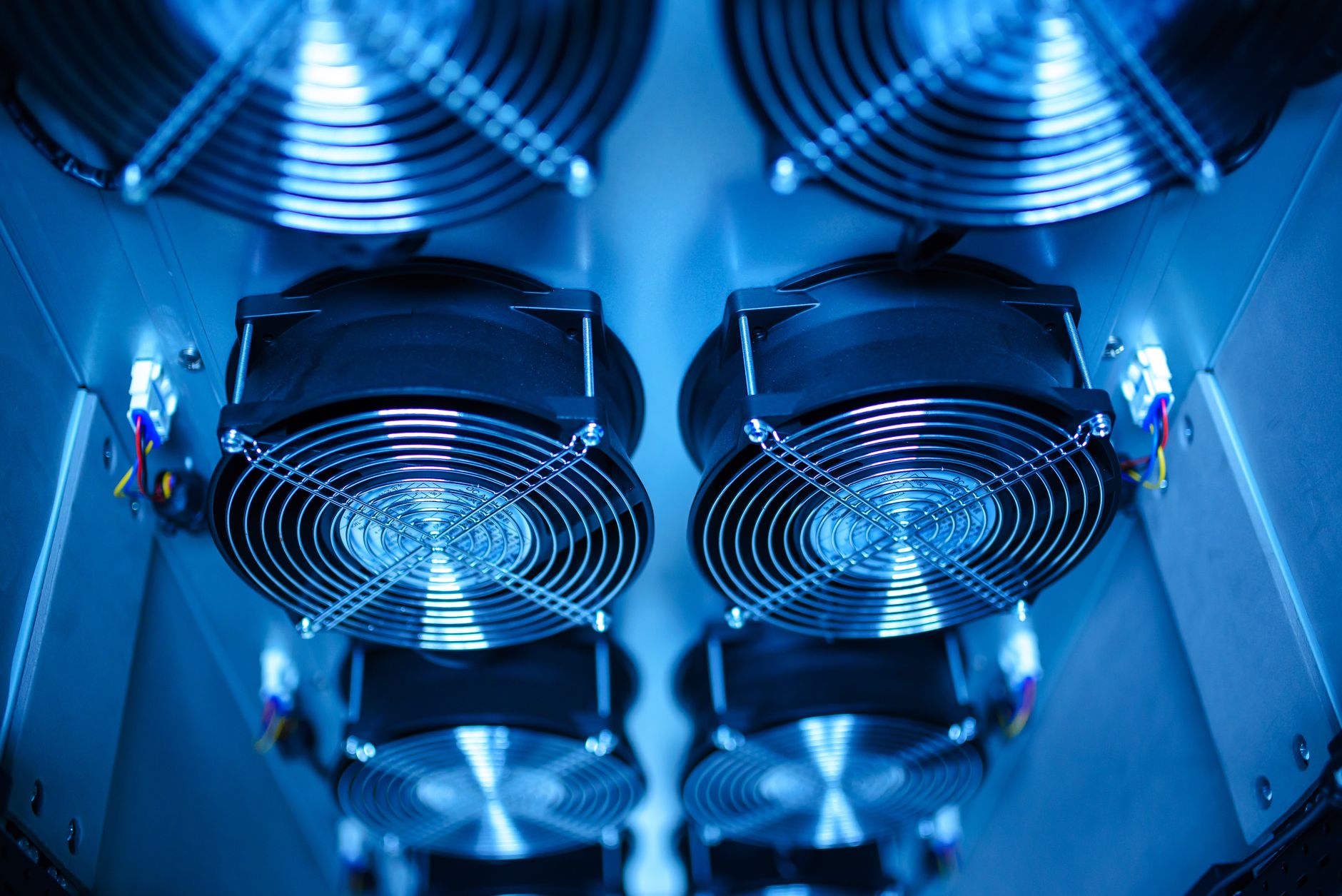
Air cooling is the traditional and most widely deployed method for removing heat from ASIC miners. The principle is simple: ambient air is drawn through the mining enclosure, passes over the ASIC heat sinks and onboard fans, absorbs thermal energy, and is exhausted as hot air.
The mechanics. Standard ASIC miners like the Antminer S21 and WhatsMiner M60 ship with built-in fans that push air across the hash boards. In a containerized or warehouse deployment, additional intake and exhaust fans maintain airflow volume. The miners are typically arranged in rows with a hot-aisle/cold-aisle configuration to prevent recirculation of heated air.
Environmental controls. In hot climates, operators may add evaporative cooling pads, misting systems, or supplemental HVAC to keep intake air within the manufacturer’s recommended operating range (typically 0–40°C / 32–104°F). In cold climates, the opposite problem emerges: condensation management and minimum temperature regulation.
Filtration. Outdoor air introduces dust, pollen, insects, and particulates that accumulate on heat sinks and fans, reducing cooling efficiency over time. Air-cooled facilities in dusty or agricultural environments require regular filter replacement and periodic hardware cleaning.
How Hydro (Liquid) Cooling Works
Hydro cooling—also referred to as liquid cooling or immersion cooling, depending on the implementation—removes heat by direct contact between a liquid coolant and the mining hardware. There are two primary variants in production use today.
Direct-to-chip (hydro cooling). Cold plates mounted directly on the ASIC chips circulate a water-glycol mixture or engineered coolant through a closed loop. The heated coolant is pumped to a heat exchanger (dry cooler or cooling tower) where the thermal energy is rejected to the atmosphere. The Antminer S21 Hydro is the most widely deployed example, with factory-integrated liquid cooling plates replacing the traditional fan-based heatsink assembly.
Single-phase immersion. The entire mining machine is submerged in a tank filled with a dielectric (non-conductive) fluid. The fluid absorbs heat across all surfaces of the hardware and is circulated to an external heat exchanger. This approach eliminates fans entirely, since the fluid provides both cooling and vibration damping.
Two-phase immersion. A more advanced variant where the dielectric fluid boils at a low temperature on contact with the hot ASIC chips, carrying heat away as vapor. The vapor condenses on a cold surface inside the tank and drips back into the bath. This is the most efficient thermal transfer method but also the most complex and expensive to implement.
Side-by-Side Comparison
| Factor | Air Cooling | Hydro / Liquid Cooling |
|---|---|---|
| Upfront Cost per MW | Lower ($50K–$100K infrastructure) | Higher ($150K–$300K+ infrastructure) |
| Cooling Efficiency | Good — climate dependent | Excellent — climate independent |
| Power Overhead (cooling) | 15–30% of IT load | 5–10% of IT load |
| PUE (Power Usage Effectiveness) | 1.15–1.30 | 1.02–1.10 |
| Noise Level | 75–85 dB (loud) | 40–55 dB (quiet) |
| Compute Density | Standard — limited by airflow | 2–3x higher — no airflow constraints |
| Hardware Lifespan | 3–4 years (fan wear, dust) | 4–6+ years (reduced thermal stress) |
| Maintenance Complexity | Simple — fan replacement, filter cleaning | Moderate — pump maintenance, fluid management |
| Overclocking Potential | Limited by thermal ceiling | 15–30% higher hashrate possible |
| Climate Sensitivity | High — performance degrades in heat | Low — consistent across conditions |
The Cost Equation
Air cooling wins on upfront cost. There is no debate about that. Standard air-cooled ASIC miners are cheaper than their hydro variants, and the infrastructure to support them (fans, ducting, filters) is well-understood and inexpensive.
But the total cost of ownership (TCO) over a 3–5 year hardware lifecycle tells a different story:
Power overhead savings. A liquid-cooled operation running at a PUE of 1.05 compared to an air-cooled operation at 1.20 saves 12.5% on total power consumption. On a 10MW deployment at $0.075/kWh, that is roughly $600,000 per year in electricity savings. Over five years, that exceeds the incremental infrastructure cost of liquid cooling.
Overclocking revenue. Hydro-cooled ASICs can safely operate 15–30% above their rated hashrate because the cooling system removes heat more efficiently. This means more hashrate per machine, fewer machines per megawatt, and more revenue per dollar of hardware capital. An S21 Hydro producing 335 TH/s versus a standard S21 at 200 TH/s represents a significant revenue uplift per rack unit.
Hardware longevity. Lower operating temperatures and the elimination of fan-related vibration extend hardware lifespan. When an S21-class machine costs $3,000–$5,000, extending its useful life by 12–24 months represents real capital savings at fleet scale.
Noise and Siting Flexibility
Air-cooled mining operations are loud. A container running 200+ air-cooled ASICs generates 80–85 dB at the enclosure wall—comparable to standing next to a highway. This creates siting constraints: noise ordinances, neighbor complaints, and zoning restrictions limit where air-cooled operations can be deployed, particularly in or near populated areas.
Liquid-cooled operations are dramatically quieter. Without onboard fans, noise levels drop to 40–55 dB—roughly the volume of a normal conversation. This opens up deployment locations that would be impossible for air-cooled rigs: industrial parks near towns, commercial properties, and sites with noise-sensitive neighbors.
For operators evaluating rural or semi-rural sites where zoning flexibility matters, the noise reduction from liquid cooling can be the difference between a viable site and a rejected permit application.
Maintenance Realities
Air cooling maintenance is straightforward but constant. Fans are consumable parts with a 12–18 month expected lifespan under continuous operation. Filters need regular replacement. Dust accumulation on heat sinks degrades cooling performance and must be addressed through periodic cleaning, either manual or compressed air. In dusty environments, this can require attention every 30–60 days.
Liquid cooling maintenance is less frequent but more specialized. Pump inspections, coolant quality monitoring, leak detection, and fluid replacement (for immersion systems) require trained technicians or established maintenance contracts. When something goes wrong with a liquid cooling system—a pump failure, a leak, a fluid contamination event—the resolution is more complex and potentially more costly than replacing a fan.
The trade-off: air cooling requires more frequent, simpler maintenance. Liquid cooling requires less frequent, more specialized maintenance. At scale, the labor savings from reduced maintenance frequency on liquid-cooled systems can be significant, particularly for operations with limited on-site technical staff.
When to Choose Air Cooling
Air cooling is the right choice when:
- Budget is the primary constraint. Lower upfront infrastructure cost makes air cooling the default for operators deploying their first 1–5MW with limited capital.
- Climate is favorable. Locations with average ambient temperatures below 25°C (77°F) can run air-cooled equipment efficiently for most of the year without supplemental cooling.
- Deployment speed is critical. Air-cooled containers can be shipped and operational faster because the cooling infrastructure is simpler to install and commission.
- On-site expertise is limited. Air-cooled systems are easier to troubleshoot with general technicians. No specialized fluid handling or pump expertise required.
When to Choose Hydro / Liquid Cooling
Liquid cooling is the right choice when:
- You are optimizing for total cost of ownership. At scale (5MW+) and over multi-year time horizons, the power savings, overclocking revenue, and hardware longevity of liquid cooling typically deliver lower TCO than air cooling.
- Climate is challenging. Hot, humid, or dusty environments degrade air-cooled performance. Liquid cooling operates consistently regardless of ambient conditions.
- Space is constrained. Liquid cooling enables 2–3x the compute density per square foot, allowing more hashrate in less physical footprint.
- Noise matters. If site permits, zoning, or neighbor relations impose noise limits, liquid cooling’s near-silent operation is a decisive advantage.
- You plan to overclock. If maximizing hashrate per machine is a priority, liquid cooling is the enabling technology.
How Rax Handles Both
Rax Mining’s NatGas Modular Data Center Units support both air cooling and hydro (liquid) cooling configurations. The choice is made at the deployment planning stage based on the operator’s hardware selection, site conditions, capital budget, and operational priorities.
For operators deploying air-cooled machines like the S21 or M60 series, the MDU is configured with high-volume intake and exhaust systems, filtration, and hot-aisle containment. For operators deploying hydro-cooled machines like the S21 Hydro, the MDU is equipped with coolant distribution manifolds, pumps, and external dry coolers.
Both configurations deliver power at $0.075/kWh for large fleets (5MW+) and $0.075/kWh for smaller operations (1–4MW). The power cost advantage applies regardless of cooling method—the choice of air versus liquid is a separate engineering decision that sits on top of the power infrastructure.
Browse available ASIC hardware bundles, including both air-cooled and hydro models, at our Buy & Host shop.
The Bottom Line
There is no universally correct answer. Air cooling is cheaper to deploy, simpler to maintain, and perfectly adequate for operations in favorable climates with standard hardware. Liquid cooling costs more upfront but delivers lower TCO at scale through power savings, overclocking, hardware longevity, and noise reduction.
The decision should be driven by your specific deployment: capital budget, climate, noise constraints, target hardware, planned scale, and operational timeline. Most successful large-scale operations in 2026 are deploying a mix of both—air cooling for rapid initial deployment and liquid cooling for high-density, high-efficiency expansion phases.
The one thing both approaches share: the lower your power cost, the more margin there is to invest in the right cooling infrastructure. Solve power first, then optimize cooling.
Need help choosing the right cooling configuration for your operation? Rax supports both air and hydro-cooled deployments in our NatGas MDU platform.
Planning your cooling strategy?
Our engineering team can help you evaluate air vs hydro cooling for your specific deployment scenario.
Phone: 718-766-8559
Email: info@rax.ae
Explore Rax Mining
- Bitcoin Miner Hosting — Competitive rates from $0.075/kWh
- NatGas MDU Units — 1MW modular datacenter containers
- Mining Profitability Calculator — Estimate your mining returns
- Our Facility — Tour our mining infrastructure