The Cooling Challenge Every Bitcoin Miner Faces
As ASIC miners grow more powerful, they generate more heat. A single Antminer S21 Pro produces over 3,500 watts of thermal energy that must be dissipated continuously. How you handle that heat directly impacts uptime, hardware longevity, and your bottom line.
Two dominant approaches have emerged: traditional air cooling and the newer immersion cooling technology. Each has distinct advantages depending on your scale, budget, and operational goals. This guide breaks down everything you need to know to make the right choice for your mining operation.
How Air Cooling Works for Bitcoin Mining
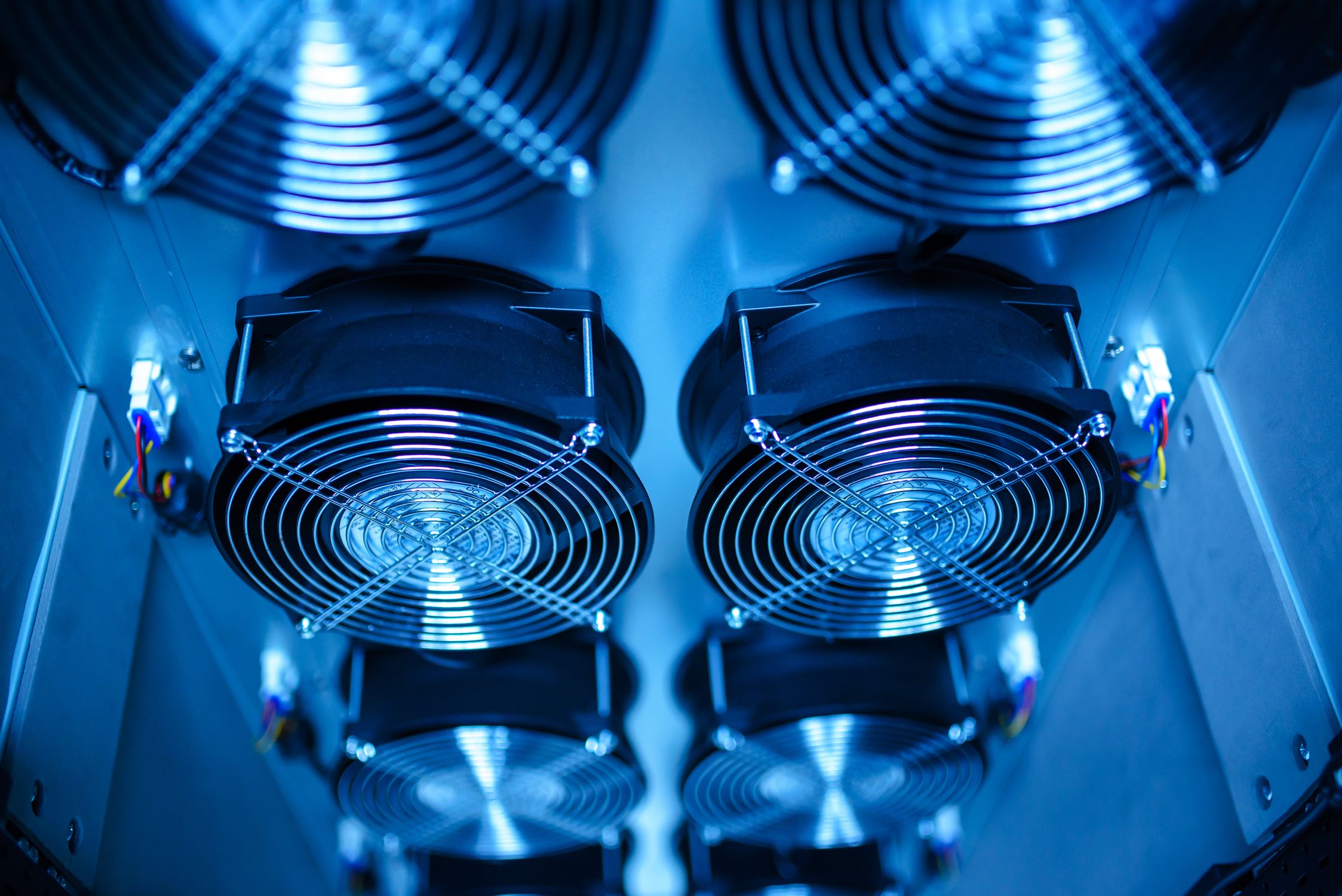
Air cooling is the standard approach used by the vast majority of mining operations worldwide. It relies on fans — both built into the ASIC miner itself and installed throughout the facility — to move ambient air across the machine’s heat sinks and exhaust hot air out of the building.
A typical air-cooled facility uses large industrial exhaust fans, intake louvers or evaporative cooling pads, and strategic rack spacing to maintain airflow. The design is straightforward: pull cool air in from one side, push hot air out the other.
Advantages of Air Cooling
- Lower upfront cost — No specialized tanks, fluids, or plumbing required. Basic ventilation infrastructure is affordable.
- Simplicity — Any electrician and HVAC contractor can set up an air-cooled mining room. No specialized training needed.
- Easy maintenance — Swapping out a miner takes minutes. No draining fluid or opening sealed containers.
- Wide compatibility — Every ASIC miner on the market ships ready for air cooling out of the box.
- Scalability — Adding more miners is as simple as plugging them in and ensuring adequate airflow.
Disadvantages of Air Cooling
- Noise — Industrial mining fans produce 75-85 dB per machine. A room of 100 miners is deafening.
- Dust and contamination — Constant airflow pulls in particulates that accumulate on circuit boards, causing failures.
- Temperature limitations — In hot climates (above 95F/35C ambient), air cooling struggles to keep miners within safe operating ranges.
- Higher failure rates — Fan bearings wear out, dust clogs heatsinks, and thermal cycling stresses solder joints.
- Energy overhead — Facility cooling fans, evaporative systems, and HVAC can add 10-20% to total power consumption.
How Immersion Cooling Works for Bitcoin Mining
Immersion cooling submerges the entire ASIC miner in a specially engineered dielectric fluid — a non-conductive liquid that absorbs heat far more efficiently than air. The heated fluid circulates to a heat exchanger where it releases thermal energy, then returns cooled to the tank.
There are two main types: single-phase immersion (fluid stays liquid throughout) and two-phase immersion (fluid boils at a low temperature, and the vapor condenses back on a cold plate). Single-phase is more common in bitcoin mining due to simpler engineering requirements.
Advantages of Immersion Cooling
- Superior heat dissipation — Dielectric fluid transfers heat 1,000 to 1,500 times more effectively than air, keeping chips cooler under load.
- Overclocking potential — With better thermal headroom, many miners can be overclocked 20-30%, increasing hashrate without hardware changes.
- Near-silent operation — No fans running means noise drops to near zero. Ideal for noise-sensitive locations.
- Longer hardware life — No dust, no fan wear, reduced thermal cycling. Miners last significantly longer.
- Extreme climate tolerance — Works in any ambient temperature since the fluid handles all thermal management internally.
- Higher density — More miners per square foot since you eliminate airflow spacing requirements.
Disadvantages of Immersion Cooling
- High upfront cost — Immersion tanks, dielectric fluid, pumps, and heat exchangers cost $150-$400+ per kW of capacity.
- Specialized maintenance — Technicians need training to work with fluid systems. Removing a miner means draining and cleaning.
- Fluid costs — Dielectric fluid runs $15-$40 per gallon and must be topped off periodically as small amounts evaporate.
- Limited vendor support — Some manufacturers void warranties on immersion-cooled units, though this is changing.
- Complexity — Plumbing, fluid management, and leak detection add operational complexity.
Cost Comparison: Air vs Immersion Cooling
For a 1 MW mining operation running approximately 280 Antminer S21 Pro units:
| Cost Category | Air Cooling | Immersion Cooling |
|---|---|---|
| Infrastructure Setup | $50,000 – $80,000 | $150,000 – $400,000 |
| Monthly Power Overhead | 10-20% additional | 2-5% additional |
| Annual Maintenance | $15,000 – $25,000 | $5,000 – $10,000 |
| Hardware Replacement Rate | 8-15% per year | 2-5% per year |
| Overclocking Potential | Limited (5-10%) | Significant (20-30%) |
Which Miners Support Immersion Cooling?
Most modern ASIC miners can be adapted for immersion cooling by removing fans and modifying the chassis. However, several manufacturers now offer immersion-ready models:
- Bitmain Antminer S21 Hydro — Purpose-built water/liquid cooling with integrated heat exchangers
- MicroBT Whatsminer M56S — Hydro-cooled variant designed for liquid cooling deployments
- Bitmain Antminer S21 XP — Can be adapted for single-phase immersion with fan removal
- Canaan Avalon Immersion — Designed specifically for immersion cooling tanks
Standard air-cooled miners like the S21 Pro and S19 XP can also be immersion-cooled after removing fans and sealing unnecessary openings. Many hosting providers offer this conversion service.
Which Cooling Method Is Right for You?
Choose air cooling if: You are starting out with fewer than 50 miners, operating in a mild climate, want the simplest setup, or need to minimize upfront capital expenditure.
Choose immersion cooling if: You are running 100+ miners at scale, operating in a hot climate, want maximum hardware longevity, need near-silent operation, or want to overclock for peak performance.
Consider a hybrid approach: Many large operations run their newest, most expensive miners in immersion while keeping older units on air cooling. This balances cost with performance where it matters most.
How Rax Mining Handles Cooling at Scale
At our hosting facilities, we engineer cooling solutions matched to each deployment’s needs. Our strategically located data centers leverage favorable climates to maximize air cooling efficiency while offering immersion options for clients who want peak performance.
Whether you choose air-cooled simplicity or immersion-cooled performance, the key is partnering with a hosting provider that understands thermal management at scale. The wrong cooling setup wastes electricity, shortens hardware life, and cuts into your profitability.
Ready to deploy your miners with professional cooling infrastructure?
Explore Rax Mining
- Bitcoin Miner Hosting — Competitive rates from $0.075/kWh
- NatGas MDU Units — 1MW modular datacenter containers
- Mining Profitability Calculator — Estimate your mining returns
- Our Facility — Tour our mining infrastructure